Customer Acquisition Cost (CAC): How to Calculate and Optimize
Customer acquisition cost (CAC) is the total amount you spend on sales and marketing divided by the number of new customers you gain in a specific period. It’s the single metric that tells you whether your growth strategy is sustainable or slowly bleeding money.
This guide covers how to calculate CAC accurately, what benchmarks actually matter for your business type, the most common reasons CAC climbs too high, and practical strategies to bring it down.
What is customer acquisition cost (CAC)
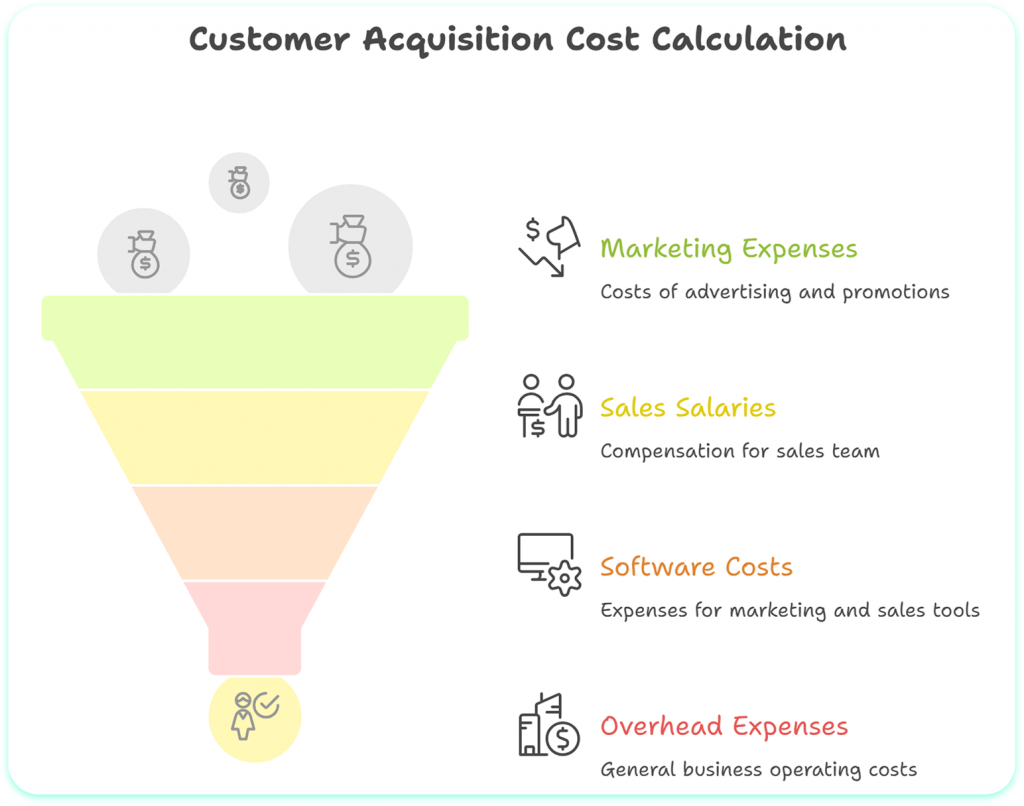
Customer acquisition cost (CAC) is the total expense—including marketing, sales salaries, software, and overhead—divided by the number of new customers acquired during a specific period. The metric tells you how efficiently your business turns spending into paying customers.
Picture spending $10,000 on Facebook ads, influencer partnerships, and email marketing tools over a month. If those efforts bring in 200 new customers, your CAC is $50. That single number represents what it actually costs to win each new buyer.
The metric applies across business types—ecommerce, SaaS, B2B services—though what counts as acceptable varies significantly. For a Shopify store selling $30 products, a $50 CAC creates a problem. For a subscription business with customers who stay for years, that same $50 might be a bargain.
How to calculate customer acquisition cost
The customer acquisition cost formula
The core formula is straightforward:
CAC = Total Sales & Marketing Expenses ÷ Number of New Customers
You can calculate CAC using a simple method that includes only ad spend, or a more comprehensive approach that factors in salaries, software subscriptions, agency fees, and overhead. The comprehensive method gives you a more accurate picture of true acquisition costs.
Whichever approach you choose, use a consistent time period—monthly, quarterly, or annually—so you can track changes over time.
What to include in your CAC calculation
To get an accurate number, include all expenses directly tied to acquiring new customers:
- Ad spend: Paid social, search ads, display campaigns, influencer fees
- Software costs: Marketing automation tools, CRM platforms, analytics subscriptions
- Salaries: Marketing and sales team compensation (proportional to acquisition work)
- Creative costs: Agency fees, freelancer work, content production
- Overhead: A proportional share of relevant operational costs
The goal is capturing the true cost of bringing in a new customer, not just the obvious line items.
CAC calculation example
Say your Shopify store spent the following in Q1:
| Expense Category | Amount |
|---|---|
| Facebook/Instagram ads | $8,000 |
| Google Ads | $4,000 |
| Email marketing software | $500 |
| Marketing team salary (proportional) | $7,500 |
| Total | $20,000 |
During that same quarter, you acquired 400 new customers.
CAC = $20,000 ÷ 400 = $50 per customer
This means you spent $50, on average, to acquire each new customer during Q1. Now you have a baseline to track against.
New CAC vs blended CAC
Not all CAC calculations measure the same thing, and the distinction matters more than most merchants realize.
New CAC measures the cost to acquire a first-time buyer—someone who has never purchased from your store before. This is the purest measure of acquisition efficiency.
Blended CAC divides total marketing costs by all customers acquired in a period, including returning customers who came back for another purchase. This number is almost always lower because repeat customers are cheaper to convert.
The problem with relying on blended CAC alone is that it can mask rising acquisition costs. If your new customer acquisition is getting more expensive but repeat purchases are holding steady, blended CAC might look fine while your growth engine is actually struggling.
Use new CAC when evaluating growth strategy and channel efficiency. Use blended CAC for measuring overall marketing ROI.
Why customer acquisition cost matters in business
Impact on profitability and ROI
CAC directly affects your profit margins. If you spend more to acquire a customer than they ever spend with you, growth becomes unsustainable—you’re essentially paying people to buy from you at a loss.
Lowering CAC or increasing what each customer spends improves your return on every marketing dollar.
Investor and funding decisions
Investors scrutinize CAC because it signals how efficiently a company can scale. A business with a $200 CAC and $150 average order value raises immediate concerns. The same CAC with a $600 customer lifetime value tells a different story.
If you’re seeking funding or preparing for acquisition, expect CAC to be a standard question in due diligence.
Marketing efficiency and sales measurement
CAC helps you compare channel performance. You might discover that paid search brings customers at $40 each while influencer partnerships cost $120 per customer. Without channel-level CAC data, you’re allocating budget based on gut feeling rather than evidence.
CAC and customer lifetime value (LTV)
How to calculate the LTV to CAC ratio
Customer lifetime value (LTV) is the total revenue a customer is predicted to generate over their entire relationship with your business. For a subscription business, this might span years. For a one-time purchase store, it’s often just the first order unless you have strong repeat purchase rates.
The ratio formula is simple:
LTV ÷ CAC = LTV:CAC Ratio
If a customer’s LTV is $150 and your CAC is $50, your ratio is 3:1. This means you earn $3 for every $1 spent on acquisition.
What is a good LTV to CAC ratio
A 3:1 ratio is a common benchmark for healthy, sustainable growth. At this level, you’re earning enough from each customer to cover acquisition costs and fund continued growth.
A 1:1 ratio means you’re breaking even on acquisition—not sustainable for long. A very high ratio (5:1 or more) might actually indicate underinvestment in marketing and missed growth opportunities.
What is a good customer acquisition cost
There’s no universal “good” CAC because the acceptable number depends entirely on your business model, product margins, and customer value.
| Business Type | CAC Considerations |
|---|---|
| Ecommerce | Typically lower CAC, lower LTV; success depends heavily on product margins |
| SaaS | Higher CAC often acceptable due to recurring subscription revenue |
| B2B | Longer sales cycles and higher contract values justify significantly higher CAC |
A $100 CAC might be excellent for a B2B software company with $10,000 annual contracts and terrible for a store selling $25 t-shirts.
The key principle: your CAC needs to be significantly lower than your LTV to ensure profitability. Evaluate your CAC relative to your own margins and customer value, not against arbitrary external benchmarks.
Common causes of high customer acquisition cost
Inefficient ad targeting and spend
Poorly targeted ads waste budget on people who will never buy. Overly broad audiences, advertising on the wrong platforms, and weak creative all drive up costs without proportional returns.
Low website conversion rates
High traffic with few conversions is a primary driver of inflated CAC. If 1,000 visitors cost you $500 in ads but only 10 convert, your CAC is $50. Improve that conversion rate to 20 customers and your CAC drops to $25—same ad spend, half the acquisition cost.
Common conversion killers like confusing navigation, slow pages, or unclear calls-to-action reduce conversions and inflate costs.
Cart and checkout abandonment
Visitors who add items to their cart but don’t complete the purchase represent wasted acquisition spend. You paid to get them to your store, they showed purchase intent, and then something stopped them.
Common causes include unexpected shipping costs, complicated checkout forms, and missing trust signals.
Weak retention and repeat purchases
If customers don’t return, you’re forced to constantly pay to acquire new ones. Strong retention effectively lowers your blended CAC because repeat customers cost far less to convert than new ones.
Underperforming marketing channels
Some channels inherently cost more per customer than others. Without channel-level analysis, you might be overspending on low-ROI sources while underinvesting in channels that could deliver customers more efficiently.
How to diagnose high customer acquisition cost
Analyze CAC by channel
Break down your CAC for each marketing channel—paid social, search, email, organic, referral. Compare the cost per customer across sources to identify which channels deliver efficiently and which drain budget.
This analysis often reveals that one or two channels are responsible for most of your high-cost acquisitions.
Review funnel drop-off points
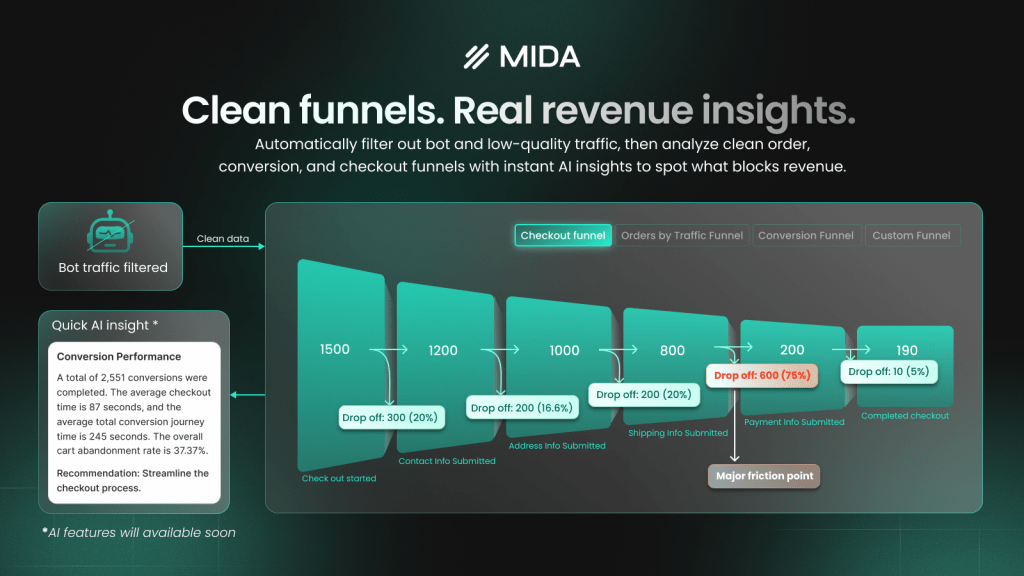
Map your conversion funnel from landing page to order confirmation. Use analytics to identify the specific steps where the largest percentage of visitors drop off.
A big drop between “add to cart” and “checkout initiated” suggests different problems than a drop between “payment info” and “purchase complete.” Comparing your numbers against funnel benchmarks tells you exactly where to focus.
Watch session replays for friction
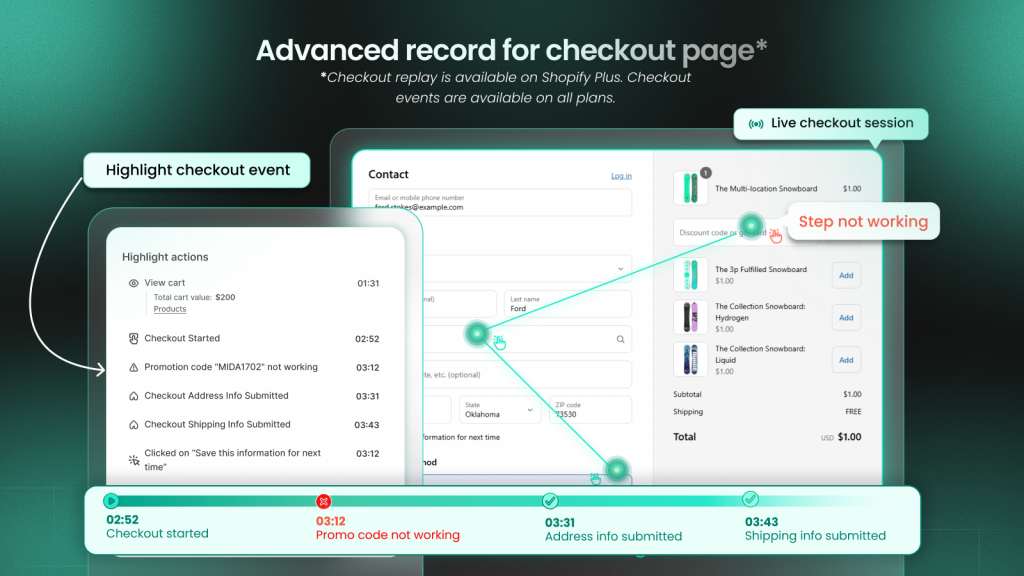
Session replay tools let you watch real shopper behavior leading up to conversion—or abandonment. You see where visitors paused, what they clicked, and where they seemed confused.
Tools like MIDA let you filter recordings to show sessions tied to specific outcomes, so you’re watching behavior that directly impacts your CAC. Look for hesitation patterns, rage clicks on unresponsive elements, or repeated scrolling that suggests shoppers are searching for something they can’t find.
Strategies to reduce customer acquisition cost
1. Improve website conversion rate
Conversion rate optimization (CRO) turns more visitors into customers from your existing traffic. If you can double your conversion rate, you effectively cut your CAC in half without changing your ad spend.
Fix UX issues like unclear CTAs, slow pages, and confusing navigation. Heatmaps and session replays reveal exactly where visitors get stuck so you can prioritize fixes based on actual behavior.
2. Optimize the checkout experience
Reduce checkout abandonment by simplifying forms, showing total costs upfront, and adding trust signals like security badges. Address common friction points: unexpected fees, required account creation, and limited payment options.
Every checkout completion you recover is a customer you already paid to acquire.
3. Retarget abandoned carts
Recover potentially lost customers through email and ad retargeting campaigns. Shoppers who abandoned their carts already showed purchase intent—they just didn’t finish.
Personalized messaging based on the items they left behind increases relevance and conversion rates.
4. Increase customer retention and LTV
Improving retention reduces your reliance on constantly acquiring new customers. Loyalty programs, post-purchase email flows, and excellent customer service all contribute.
A higher LTV means you can afford a higher CAC and still remain profitable, giving you more flexibility in your acquisition strategy.
5. Focus spend on high-performing channels
Use your channel-level CAC data to reallocate budget. Double down on sources that deliver low-cost, high-quality customers. Scale back or optimize channels with poor efficiency.
6. Grow organic and referral traffic
Invest in SEO and content marketing to reduce dependency on paid ads over time. Encourage customer referrals—referral customers often have very low acquisition costs and tend to convert at higher rates.
Organic traffic compounds. Paid traffic stops the moment you stop paying.
Start measuring what drives your acquisition costs
CAC tells you how much you spend to acquire customers, but understanding why that number is high—or how to lower it—requires seeing what shoppers actually do on your site.
Diagnosing and fixing friction points in your conversion funnel is the most sustainable way to reduce CAC. When you can watch the exact session behind an abandoned cart or a failed checkout, you stop guessing and start fixing.
See exactly where your shoppers drop off and why.
FAQs about customer acquisition cost
What is the difference between CAC and cost per acquisition?
CAC measures the total cost to acquire a paying customer, while cost per acquisition (CPA) typically refers to the cost of a specific action—like a sign-up, lead form submission, or app install. CPA doesn’t always result in a paying customer, which is why the two metrics can differ significantly.
How do you calculate CAC for a Shopify store?
Sum all your marketing and sales expenses for a period, then divide by the number of new customers acquired during that same period. Include ad spend, software subscriptions, and any agency or freelance costs directly tied to acquisition.
What is CAC payback period?
CAC payback period is the time it takes for a customer’s revenue to cover the cost of acquiring them. A three-month payback period means you recoup your acquisition investment within three months. Shorter payback periods indicate healthier cash flow.
Are salaries included in CAC calculations?
Yes—include the salaries of marketing and sales team members whose work directly contributes to acquiring new customers. This gives you a more accurate picture of true acquisition costs rather than just ad spend.
How often do you measure customer acquisition cost?
Measure CAC at least monthly to spot trends and react to changes quickly. Quarterly reviews help identify longer-term patterns and seasonal effects that monthly data might obscure.

Hien Tran
I’m Hien Tran, a Product Marketing Executive at MIDA, specializing in eCommerce growth and conversion optimization. I focus on bridging product capabilities with real merchant needs—turning insights from heatmaps, session replays, and funnel analytics into actionable strategies that drive measurable results.


