Mida vs Hotjar: Which Tool Delivers Better Results for Shopify Merchants?
When you’re trying to understand why shoppers abandon your cart or bounce from your product pages, session recordings and heatmaps give you the visibility that standard analytics can’t. Both Mida and Hotjar promise to show you what’s happening on your store—but the devil is in the details.
Hotjar is a well-established behavior analytics platform used across industries, offering session recordings, heatmaps, surveys, and funnels. Mida is built exclusively for Shopify, with features designed around the specific behaviors that drive ecommerce revenue: checkout abandonment, add-to-cart friction, and customer journey tracking tied directly to orders.
If you’re a Shopify merchant trying to decide which tool will actually help you fix what’s costing you sales, this comparison will walk you through the differences that matter—features, usability, pricing, support, integrations, and how each platform handles the pain points real users face every day.
Key Features and Capabilities
Session Recording: Generic Playback vs. Shopify-Native Context
Hotjar’s session recordings show you what happened on your site, but users consistently report accuracy issues. Multiple reviewers mention that “many of our DOM interactions were not recorded leading to us identify them as bugs”—meaning you might watch a recording that looks broken when the actual customer experience was fine, or miss critical interactions entirely. When recordings don’t match reality, you waste time chasing false problems instead of fixing real ones.
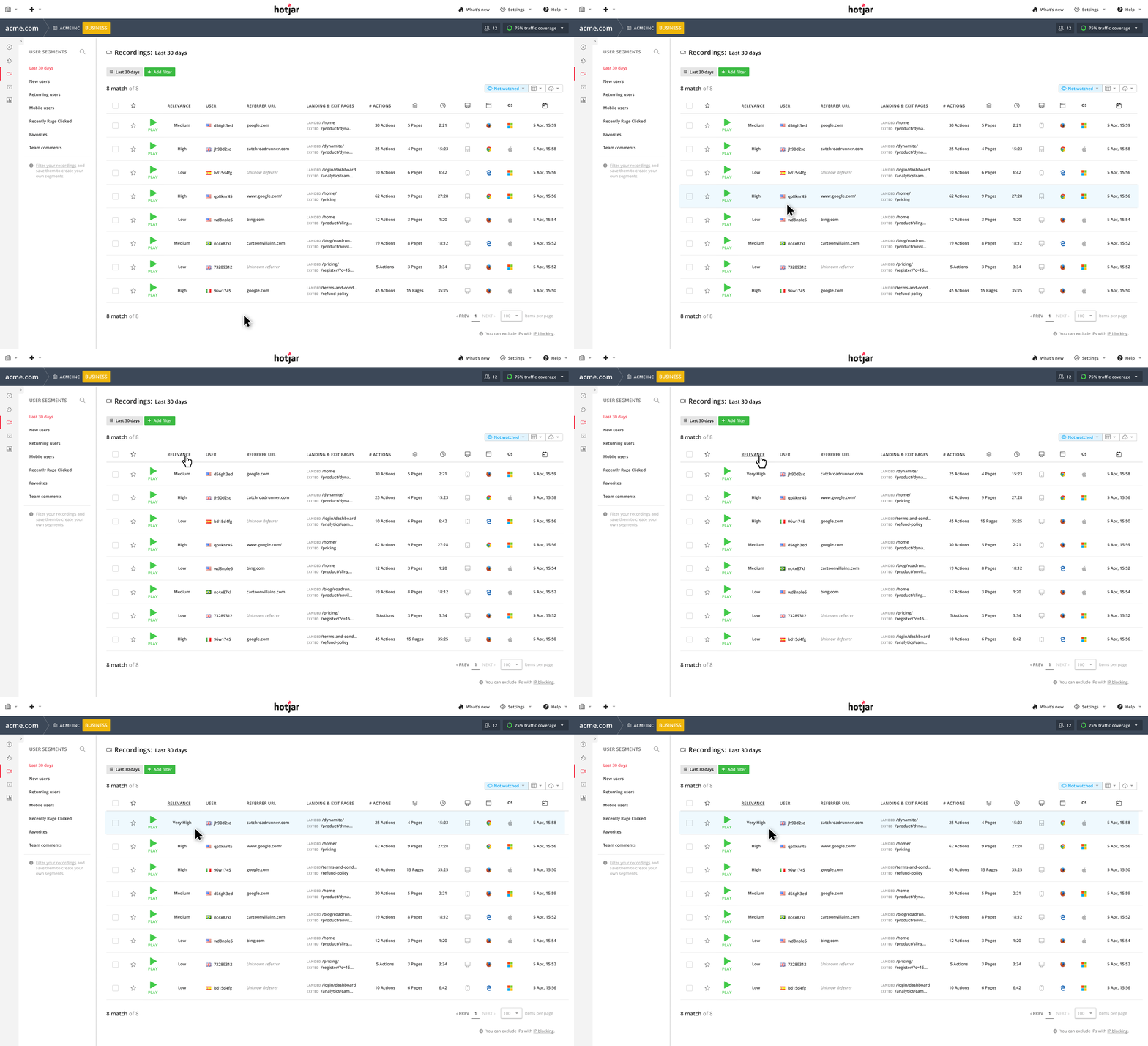
Mida’s session replays are built exclusively for Shopify, which means every recording includes the commerce context that matters: customer profile, cart value, order status, and checkout events. You can filter recordings by abandoned checkout, first-time vs. returning visitors, cart value thresholds, and engagement signals like rage clicks or error clicks. The Relevance Score automatically surfaces the sessions most likely to reveal friction—so you’re not scrolling through hundreds of recordings hoping to find the one where something went wrong.

When you watch a Mida replay, you see exactly what happened before the abandonment: did they hesitate at shipping costs? Did a form field throw an error? Did they rage-click a button that didn’t respond? You’re watching real Shopify behavior, not a generic web session.
Heatmaps: Pretty Colors vs. Revenue-Focused Insights
Hotjar’s heatmaps show clicks, scrolls, and movement—but they’re capped at 1500px page height, which means if you have long product pages or detailed landing pages, you’re losing data on everything below the fold. Users also report that heatmaps don’t connect to outcomes: you can see where people clicked, but you can’t tell if those clicks led to carts or just bounces.
Mida heatmaps are designed to answer the question every merchant actually cares about: which elements drive revenue? You get click maps, move maps, and scroll depth analysis, but you also see element-level CTR, rage clicks, dead clicks, and error clicks—so you know not just where shoppers clicked, but whether those clicks worked, frustrated them, or led nowhere.

More importantly, Mida connects heatmaps directly to session replays. When you see a hotspot on a button or a cluster of rage clicks on a dropdown, you can click through to watch the exact sessions where those interactions happened. That means you’re not guessing why an element got attention—you’re watching the behavior that created the heatmap pattern in the first place.
Funnels and Conversion Tracking: Page Views vs. Shopify Checkout Steps
Hotjar offers funnel tracking, but users report accuracy issues and note that it doesn’t integrate with Google Analytics conversion goals—so you can’t filter recordings by whether someone completed a purchase or specific objective. The funnel view shows drop-offs between pages, but it’s not built around the Shopify checkout flow, and it doesn’t connect funnel data to the sessions where abandonment happened.
Mida’s Order Funnel Visualization is built specifically for Shopify’s commerce journey: product view → add to cart → checkout → order. You see exactly where drop-offs occur, and you can click into any funnel step to watch the sessions where shoppers exited. If 40% of users who reach checkout abandon at the shipping step, you can immediately watch those exact sessions to see what caused the friction—unexpected costs, confusing forms, or technical errors.
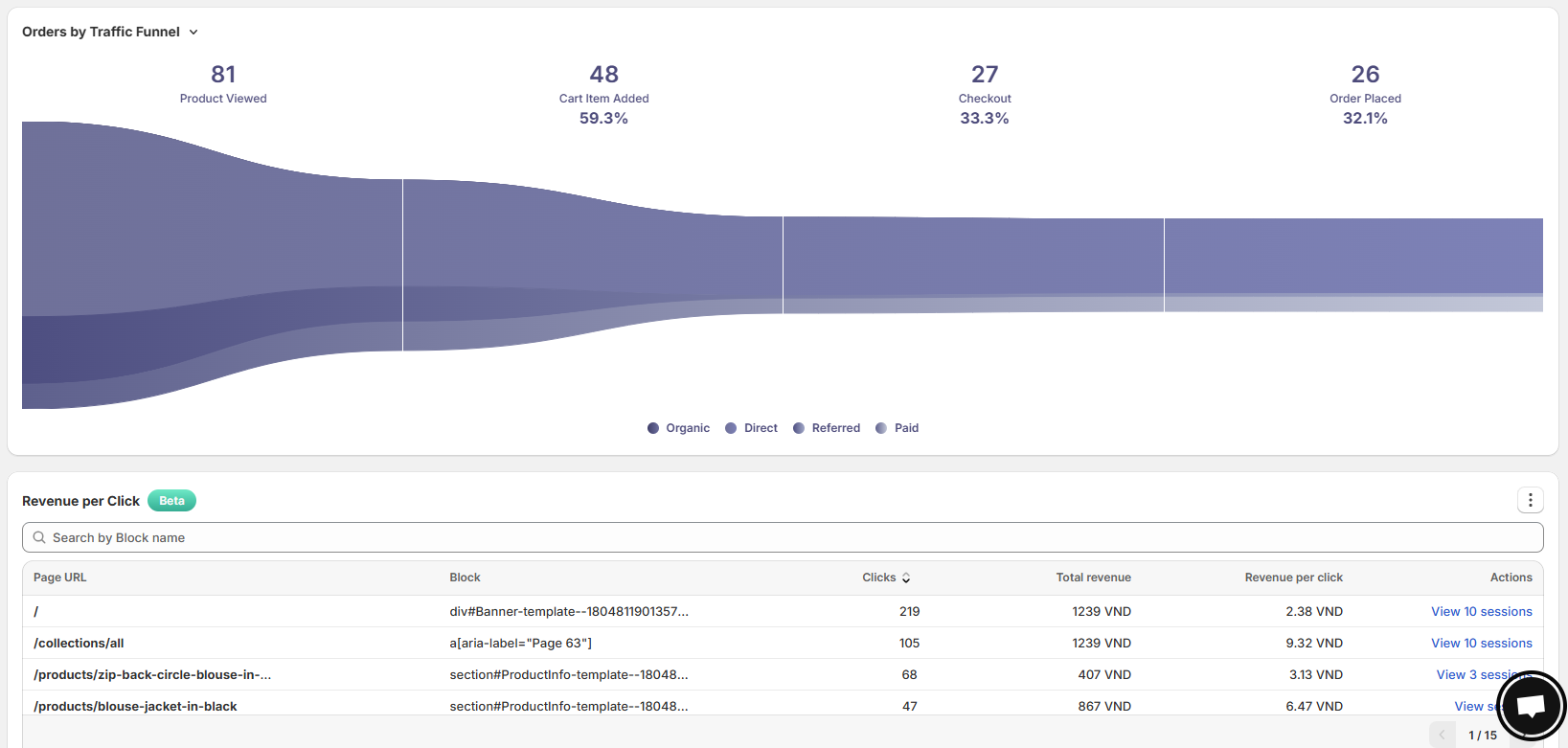
MIDA conversion funnel and revenue per click by element tracking
Because Mida is Shopify-native, every funnel step is tied to real checkout events and order data, not just page URLs. That means you’re tracking true buyer behavior, not proxy metrics.
Surveys and Feedback: Disconnected Responses vs. Behavior-Linked Context
Hotjar’s surveys capture voice-of-customer feedback, but users consistently complain about the editing workflow: you can’t fix even a small typo without creating a new question and splitting your results into two columns. There’s no internal naming system, no way to archive reviewed responses, and no conditional logic for thank-you pages based on answers. More critically, survey responses aren’t linked to session recordings—so when someone says “checkout was confusing,” you have no way to watch what they actually experienced.
Mida’s Targeted On-Site Surveys let you ask focused questions on specific pages or devices, and every response is linked directly to the session recording. When a shopper says they abandoned because of shipping costs, you click Play and watch their exact journey—where they hesitated, what they clicked, and what they saw before they left. Feedback isn’t just a comment in a spreadsheet; it’s a doorway into the full behavioral context behind every answer.

Automated Insights: Manual Review vs. AI-Powered Summaries
One of the most consistent complaints about Hotjar is the lack of automated insights. Users describe being overwhelmed by “too much information” with no AI-powered summarization or pattern detection. You’re left manually reviewing hundreds of recordings and heatmaps, hoping to spot trends—and as one reviewer put it, “Sometimes there can be too much information—too much of a good thing.”
Mida includes AI-Powered Weekly Email Reports that automatically summarize your shop health score, abandoned carts, user engagement levels, traffic patterns, and performance trends. Instead of logging in every day to hunt for problems, you receive a structured summary that highlights what changed, what’s working, and where friction increased—so you can prioritize improvements based on real behavior shifts, not guesswork.
User Experience and Ease of Use
Setup and Implementation
Hotjar users praise the platform’s ease of setup—most report getting it running in under 10 minutes via Google Tag Manager. However, some users note performance concerns on high-traffic sites with shared hosting, and there are recurring mentions of configuration challenges with certain frameworks (Angular JS forms don’t work properly, for example).
Mida is designed for Shopify merchants who want to start seeing behavior data immediately, without developer help. Installation is a one-click Shopify app install—no tag manager, no code injection, no performance trade-offs. Because it’s built natively for Shopify, Mida automatically captures checkout events, customer profiles, and order data without custom configuration. You’re not setting up goals or defining funnels manually; the platform understands Shopify’s structure out of the box.
Daily Workflow and Navigation
Hotjar’s interface is clean and well-documented, but users consistently mention the challenge of sifting through large volumes of data without automated prioritization. There’s no way to configure daily recording limits based on business needs, and no built-in system to surface the most important sessions first. Agencies managing multiple clients appreciate the multi-site capability, but individual merchants often feel lost in the volume.
Mida’s interface is built around the questions Shopify merchants actually ask: Why are carts being abandoned? Which pages are causing bounces? What’s different about customers who convert vs. those who leave? The Relevance Score automatically ranks sessions by likelihood of revealing friction, and reusable Views let you save filters for recurring analysis (e.g., “abandoned checkouts over $100” or “mobile users who rage-clicked”). You’re not starting from scratch every time you log in—you’re jumping straight to the behavior that matters.
Collaboration and Sharing
Hotjar offers tagging, filtering, and annotation features that enable team collaboration, and users highlight the value of using recordings as evidence to sell UX changes to stakeholders. However, the lack of internal naming for surveys and inability to archive reviewed results creates organizational friction for teams managing multiple projects.
Mida’s heatmaps and session replays are designed to be shared with your team—developers, designers, and stakeholders—without requiring everyone to become analytics experts. You can share a specific recording or heatmap with a direct link, and because every session includes Shopify context (customer, cart, order), your team sees the full picture without needing a walkthrough. When you’re making the case for a checkout redesign or a product page layout change, you’re showing real customer behavior, not just your opinion.
Pricing and Value
The Free Alternative Problem
Pricing is Hotjar’s most significant vulnerability. Multiple reviewers explicitly mention that Microsoft Clarity offers the same core features—session recordings and heatmaps—completely free, making Hotjar’s cost “difficult to justify.” At least one long-term user (2+ years) churned specifically because Clarity provided feature parity at no cost, rating Hotjar only 4/10 for likelihood to recommend.
The Plus plan, which limits users to 100 daily sessions, is described as insufficient value—users feel it should offer at least 300 sessions at that price point. For Shopify merchants running paid campaigns or experiencing traffic spikes, hitting a daily cap means you’re blind during the moments that matter most.
Mida’s Transparent, Shopify-Focused Pricing
Mida offers a generous free plan that gives you real visibility into customer behavior without requiring a credit card. Paid tiers scale based on your store’s traffic and feature needs, but critically, you’re never paying for generic web analytics features you don’t need—every dollar goes toward Shopify-specific capabilities like checkout recording, order-linked sessions, and abandoned cart analysis.
Because Mida is purpose-built for Shopify, you’re not subsidizing features designed for SaaS companies or content publishers. You’re paying for the exact behavior data that drives ecommerce revenue: cart abandonment insights, checkout friction detection, and customer journey tracking tied to actual orders.
ROI and Business Impact
Hotjar users do report measurable ROI—some mention “millions of extra dollars” in revenue and “tens of thousands of dollars” saved in development time. However, these outcomes require significant manual effort: watching hundreds of recordings, synthesizing patterns, and building business cases without automated support.
Mida’s ROI comes from focus: you’re not watching every session hoping to find a problem. You’re filtering for abandoned checkouts over a certain cart value, watching sessions where rage clicks occurred, and reviewing feedback linked to the exact moment of friction. The AI-powered weekly reports quantify changes in shop health, engagement, and abandonment rates—so you can measure impact without building custom dashboards or exporting data to spreadsheets.
Customer Support
Hotjar users describe support quality as mixed. While the knowledge base and documentation are strong for self-service, at least one reviewer characterized the support team as “not the best.” For a platform that requires manual interpretation of large data volumes, lack of responsive, expert support can leave merchants stuck when they’re trying to diagnose complex behavior patterns.
Mida is built by a team that understands Shopify merchants’ daily challenges—cart abandonment, checkout friction, and conversion optimization under tight timelines. Support isn’t just about answering technical questions; it’s about helping you interpret what you’re seeing and prioritize what to fix first. Because the platform is Shopify-native, support conversations start with shared context: they understand your checkout flow, your customer profiles, and the specific friction points that cost Shopify stores revenue.
Integration Capabilities
Hotjar’s Integration Gaps
Hotjar integrates via Google Tag Manager and offers some third-party connections, but users consistently mention critical gaps:
- No Google Analytics 4 integration to filter recordings by conversion goals or segment by GA audiences
- Cross-domain tracking was removed, creating blind spots for businesses with multiple domains
- Limited API capabilities for pulling survey data into CRM systems with account-level attribution
- No native ecommerce platform integration—Hotjar doesn’t understand Shopify checkout events, cart data, or order context
For Shopify merchants, this means Hotjar sits alongside your store rather than inside it. You’re manually connecting behavior data to revenue outcomes, and you can’t filter sessions by Shopify-specific signals like abandoned checkout, customer lifetime value, or order status.
Mida’s Shopify-Native Integration
Mida is built directly into Shopify’s ecosystem, which means it automatically captures and connects:
- Customer profiles—see which sessions belong to first-time visitors vs. returning customers
- Order data—link every session to purchase outcomes and cart values
- Checkout events—track exactly where shoppers abandon during the checkout flow
- Product and collection context—understand behavior on specific product pages, not just generic URLs
- Cart and abandoned checkout data—filter sessions by cart value, items, and abandonment stage
Because Mida lives inside Shopify, you don’t need to set up custom events, define goals manually, or export data to connect behavior to revenue. The integration is automatic, and every session recording, heatmap, and funnel view includes the commerce context that tells you whether a behavior pattern is costing you sales or driving conversions.
Addressing Specific Pain Points
Recording Accuracy and Trust
The Problem: Hotjar users report that session recordings sometimes fail to capture DOM interactions accurately, showing websites differently than they actually render. This leads teams to waste time identifying false bugs and reduces trust in the data—if you can’t rely on what you’re seeing, you can’t confidently make changes based on it.
How Mida Solves It: Mida’s session replays are built specifically for Shopify’s storefront and checkout architecture, ensuring accurate capture of interactions, form submissions, and dynamic content. Because the platform is purpose-built for Shopify, it handles the framework’s specific rendering patterns and checkout flows without the accuracy issues that plague generic recording tools.
Overwhelming Data Without Prioritization
The Problem: Hotjar users consistently mention being overwhelmed by “too much information” with no automated way to identify patterns or prioritize which recordings to watch first. Without AI-powered insights or anomaly detection, you’re manually reviewing hundreds of sessions hoping to spot the friction that’s costing you sales.
How Mida Solves It: Mida’s Relevance Score automatically ranks sessions by likelihood of revealing friction, and the platform surfaces rage clicks, dead clicks, error clicks, and hesitation patterns without requiring manual review. The AI-powered weekly reports summarize behavior trends, abandonment spikes, and engagement changes—so you know what to investigate first, not just that something changed.
Disconnected Feedback and Behavior
The Problem: Hotjar’s surveys capture what customers say, but responses aren’t linked to session recordings. When someone reports that “checkout was confusing,” you have their comment but no way to watch what they actually experienced—so you’re guessing at the root cause instead of seeing it.
How Mida Solves It: Every survey response in Mida is linked directly to the session recording. When a shopper says they abandoned because of unexpected shipping costs, you click Play and watch their exact journey—where they hesitated, what they clicked, and what they saw before they left. Feedback isn’t just a data point; it’s a doorway into the full behavioral context behind every answer.
Funnel Accuracy and Checkout Visibility
The Problem: Hotjar users report that conversion funnel tracking can be inaccurate, and the platform doesn’t integrate with Google Analytics conversion goals. More critically, Hotjar’s funnels aren’t built around Shopify’s checkout flow—so you’re tracking page-to-page navigation rather than true commerce steps like add-to-cart → checkout → order.
How Mida Solves It: Mida’s Order Funnel Visualization is built specifically for Shopify’s commerce journey, tracking product view → add to cart → checkout → order with full visibility into checkout events. You see exactly where drop-offs occur, and you can click into any funnel step to watch the sessions where shoppers abandoned. Because Mida is Shopify-native, every funnel step is tied to real checkout events and order data, not just page URLs.
Flexible Recording Limits and Sampling
The Problem: Hotjar’s daily session recording limits are fixed by plan tier and can’t be configured based on business needs. If you run a flash sale, launch a new product, or experience a traffic spike, you’re stuck with the same recording cap—so you might miss the exact moments when friction spikes or new issues emerge.
How Mida Solves It: Mida’s recording approach is designed around the sessions that matter most for Shopify revenue: abandoned checkouts, high-value carts, frustrated visitors (rage clicks, error clicks), and first-time vs. returning customer journeys. You’re not recording every session indiscriminately; you’re capturing the behavior patterns that reveal friction and drive optimization decisions.
Cross-Domain and Page Height Limitations
The Problem: Hotjar removed cross-domain tracking, creating blind spots for businesses with multiple domains. Additionally, page height capture is capped at 1500px, which means long product pages, detailed landing pages, or content-heavy pages lose data on everything below the fold.
How Mida Solves It: Mida is built for Shopify’s single-domain storefront architecture, so cross-domain tracking isn’t a concern for most merchants. For page height, Mida captures full-page behavior without arbitrary limits—so whether you have short product pages or long-form landing pages, you see complete scroll depth, click patterns, and interaction data from top to bottom.
Which Tool Is Right for Your Shopify Store?
Hotjar is a capable, well-established behavior analytics platform that works across industries and website types. If you’re running a content site, SaaS product, or multi-platform business, Hotjar’s broad feature set and extensive documentation can provide value—assuming you’re willing to invest significant time manually reviewing recordings, building custom funnels, and synthesizing patterns without automated support.
But if you’re a Shopify merchant focused on reducing cart abandonment, fixing checkout friction, and increasing revenue, Hotjar’s limitations become clear:
- Recording accuracy issues that waste time on false bugs
- No integration with Shopify checkout events, customer profiles, or order data
- Fixed daily recording limits that can’t adapt to traffic spikes or business priorities
- No automated insights or AI-powered prioritization to surface friction patterns
- Survey responses disconnected from the behavior that caused them
- Funnel tracking that doesn’t align with Shopify’s commerce journey
- Pricing pressure from free alternatives offering similar core features
Mida is purpose-built for exactly what you’re trying to do: understand why shoppers abandon carts, identify friction in your checkout flow, and connect behavior to revenue outcomes. Every feature—session replay, heatmaps, funnels, surveys, and AI-powered reports—is designed around the specific behaviors that drive Shopify conversions.
You’re not adapting a generic tool to fit ecommerce; you’re using a platform that understands Shopify checkout flows, customer journeys, and abandoned cart patterns out of the box. You’re not manually reviewing hundreds of recordings hoping to find problems; you’re filtering for abandoned checkouts over $100, watching sessions where rage clicks occurred, and reviewing feedback linked to the exact moment of friction.
When you can see exactly where customers get stuck—and watch the real behavior behind every abandonment—you stop guessing and start fixing the issues that block revenue.
Ready to see your Shopify store through your customers’ eyes?
Stop relying on guesswork. Start watching real customer behavior, identify exactly where friction costs you sales, and turn cart abandonment into clarity.


