Mida vs Crazy Egg: Which Tool Delivers Better Results for Shopify Stores?
When shoppers abandon carts or drop out at checkout, page views won’t tell you why—behavior will. Both Mida and Crazy Egg offer heatmaps and session recordings, but they’re built for very different jobs. Mida is designed exclusively for Shopify, connecting clicks, hesitation, checkout behavior, and orders in one clear flow. Crazy Egg works across all websites, but lacks the ecommerce context Shopify stores rely on to track revenue impact. This comparison breaks down how Mida and Crazy Egg differ across features, usability, pricing, support, and—most importantly—their ability to help you fix the friction that’s costing you sales. Explore now!
>> You may also like:
- 10 Best Crazy Egg Alternatives for Heatmaps and Session Replay in 2026
- Best Shopify Heatmap Apps: 12 Tools Tested for Performance in 2026
Key Features and Capabilities
Shopify-Native vs. Platform-Agnostic Analytics
Crazy Egg provides solid visual analytics—heatmaps, session recordings, scroll maps, and A/B testing—that work across any website. Users consistently praise its intuitive interface and the clarity of its behavioral insights. One reviewer noted, “The UI is quite intuitive and it took little time to get an understanding,” while another described it as showing “the why, not just the what.”
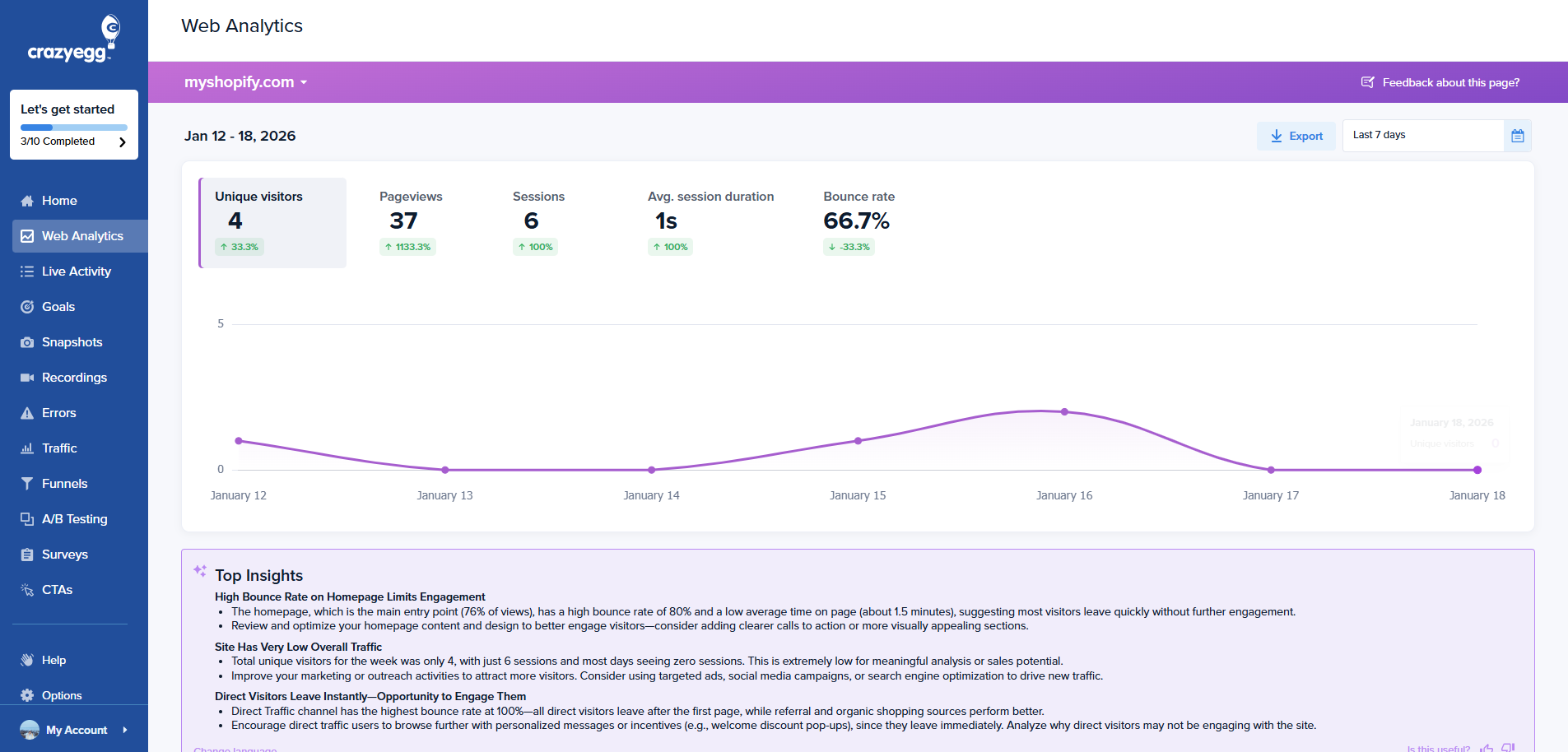
But here’s the constraint: Crazy Egg treats your Shopify store like any other website. It doesn’t know what a checkout event is. It can’t filter sessions by abandoned checkout, cart value, or whether a visitor became a customer. It doesn’t connect recordings to Shopify customer profiles or order IDs. You’re watching behavior in isolation, without the commerce context that tells you whether a session mattered for revenue.
Mida is built exclusively for Shopify. Every session recording is linked to customer-level data—cart value, order status, customer type (first-time vs. returning), and checkout progression. You can instantly filter to watch only sessions where shoppers abandoned checkout, added high-value items to cart, or encountered errors during payment. When you see a frustrated visitor rage-clicking on your checkout button, you can immediately check whether they’re a repeat customer, what their cart contained, and whether they’ve tried to complete the order before.
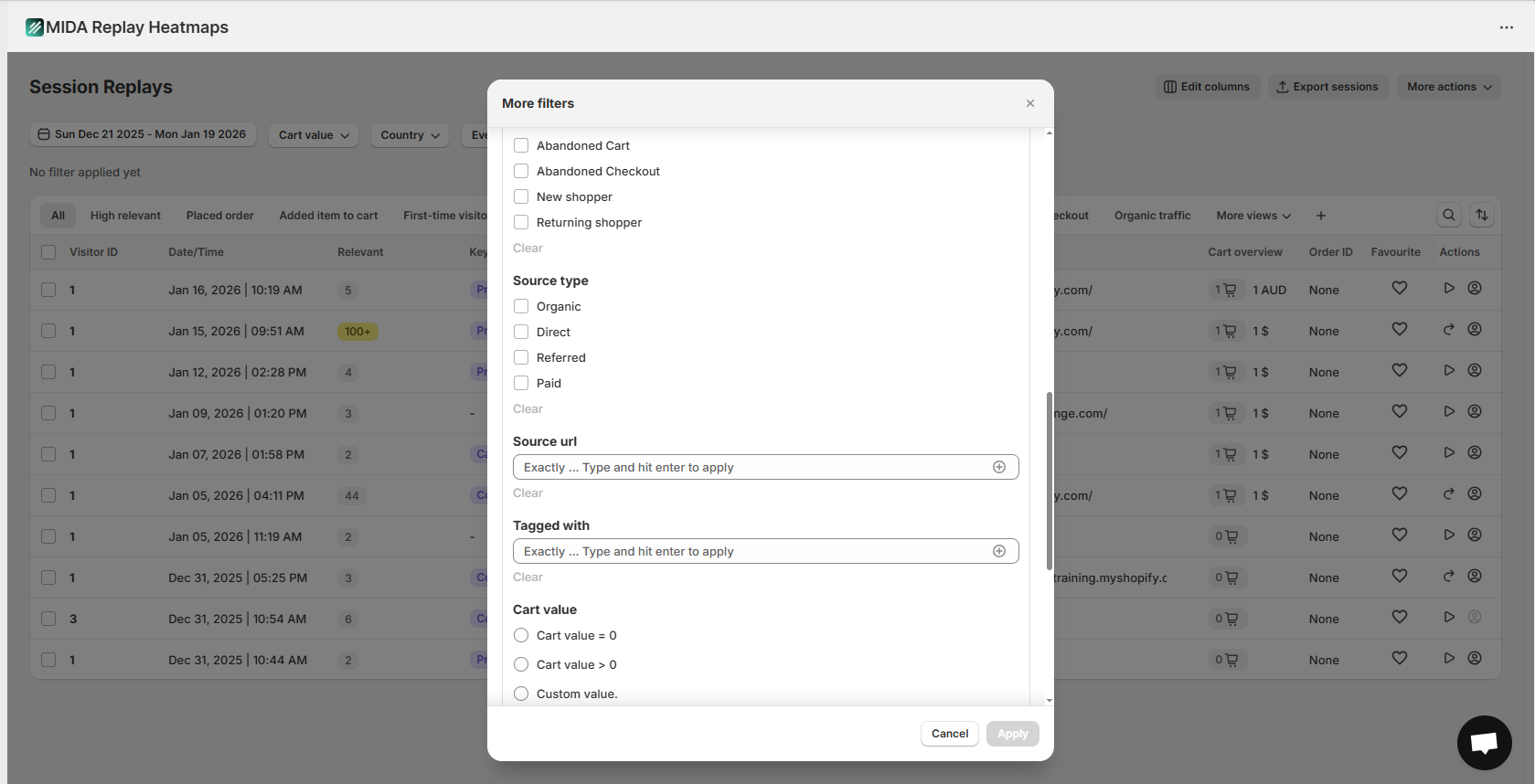
MIDA session replay with advanced filter
This isn’t a minor convenience—it’s the difference between watching random website visits and diagnosing specific revenue blockers.
Session Recording Capacity and Segmentation
One of the most consistent complaints about Crazy Egg is recording limits. Users report that “the session recording limit is low for the number of pages we have running at any given time,” and enterprise reviewers note that “the amount of recordings are sometimes not sufficient for an organisation as big as ours.” If you’re running a catalog with hundreds of products or testing multiple landing pages simultaneously, you’ll hit capacity constraints quickly—forcing you to choose which pages to monitor or miss critical sessions entirely.
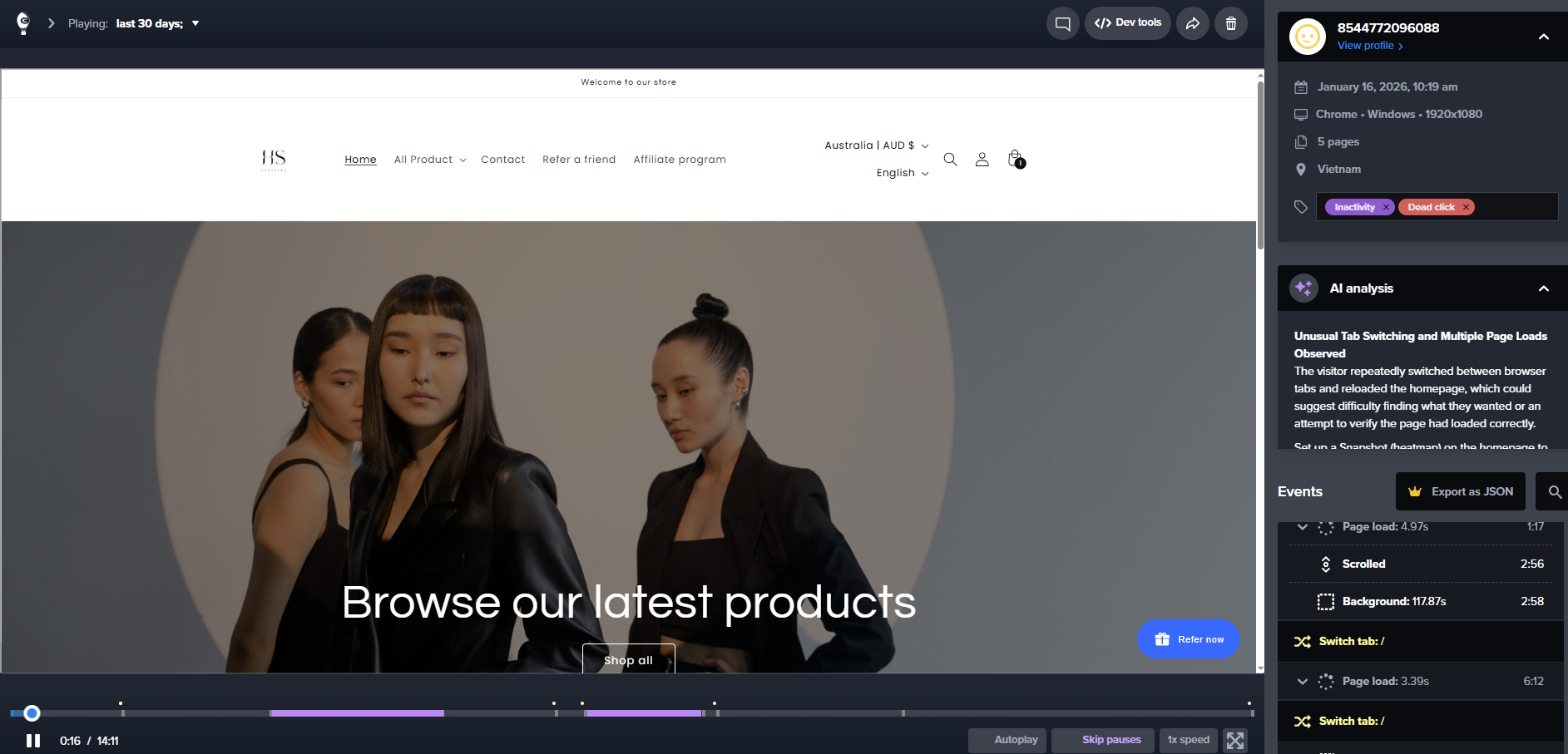
Crazy Egg replays with AI insight
Mida’s approach is different. Rather than capping recordings arbitrarily, Mida uses a Relevance Score to prioritize the sessions that matter most: engaged visitors, frustrated users (rage clicks, dead clicks, error clicks), cart abandoners, and completed purchases. You’re not watching every idle session—you’re watching the journeys that reveal friction or validate what’s working. And because Mida is Shopify-native, you can create reusable Views that automatically surface sessions matching specific criteria—like “abandoned checkout with cart value over $100” or “mobile visitors who rage-clicked on product images.”
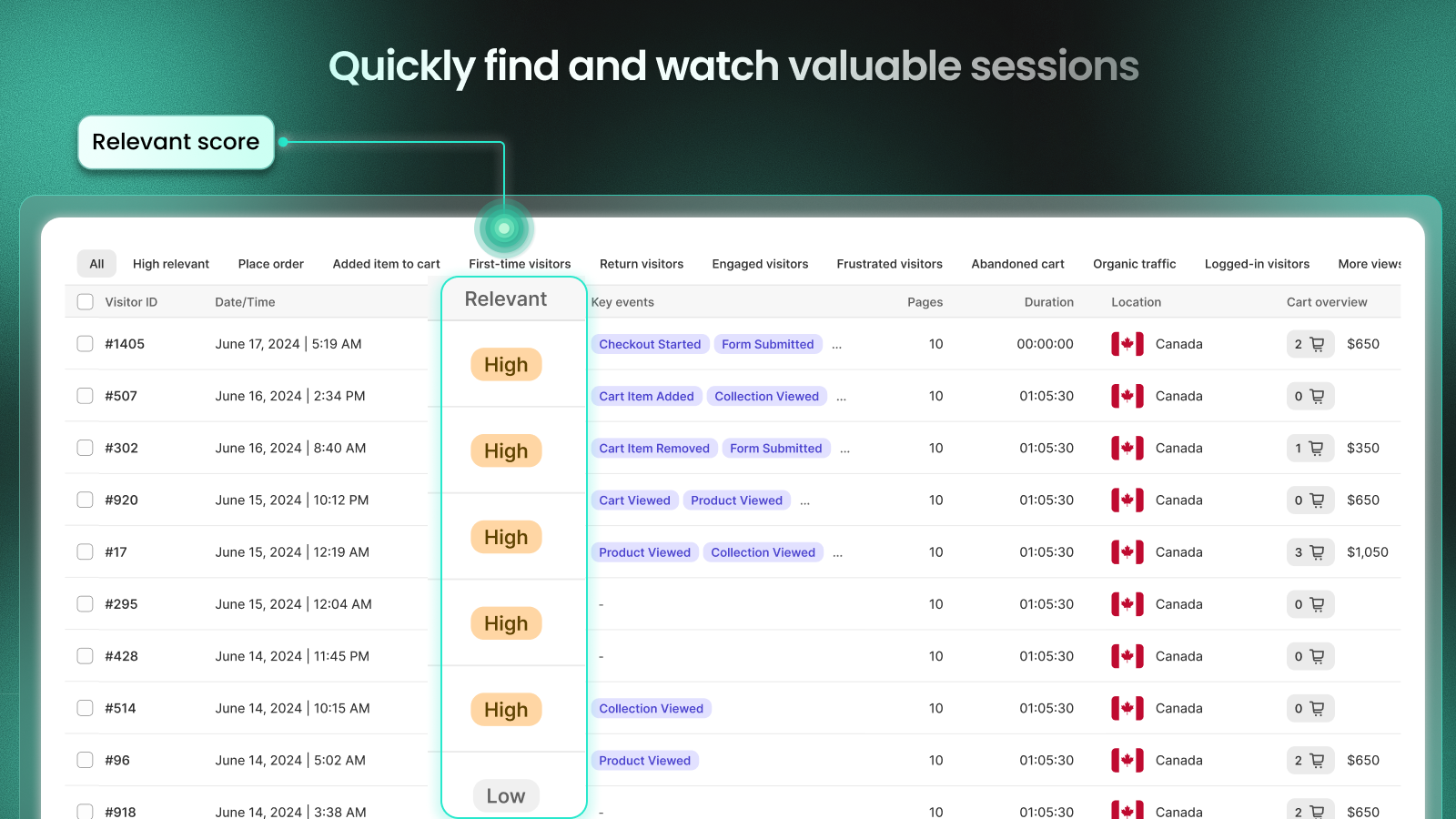
This segmentation is built into the product, not bolted on. You don’t need to export data or build custom filters in a separate tool. You click a saved View and immediately watch the sessions where revenue was at risk.
Heatmaps That Connect to Revenue, Not Just Clicks
Crazy Egg’s heatmaps are visual and easy to interpret—users appreciate seeing click patterns, scroll depth, and movement overlays. But the tool stops at showing you where people clicked. It doesn’t tell you whether those clicks led to carts, checkouts, or orders. You see a hot spot on a product image, but you don’t know if that element actually drives conversions or just attracts attention without converting.
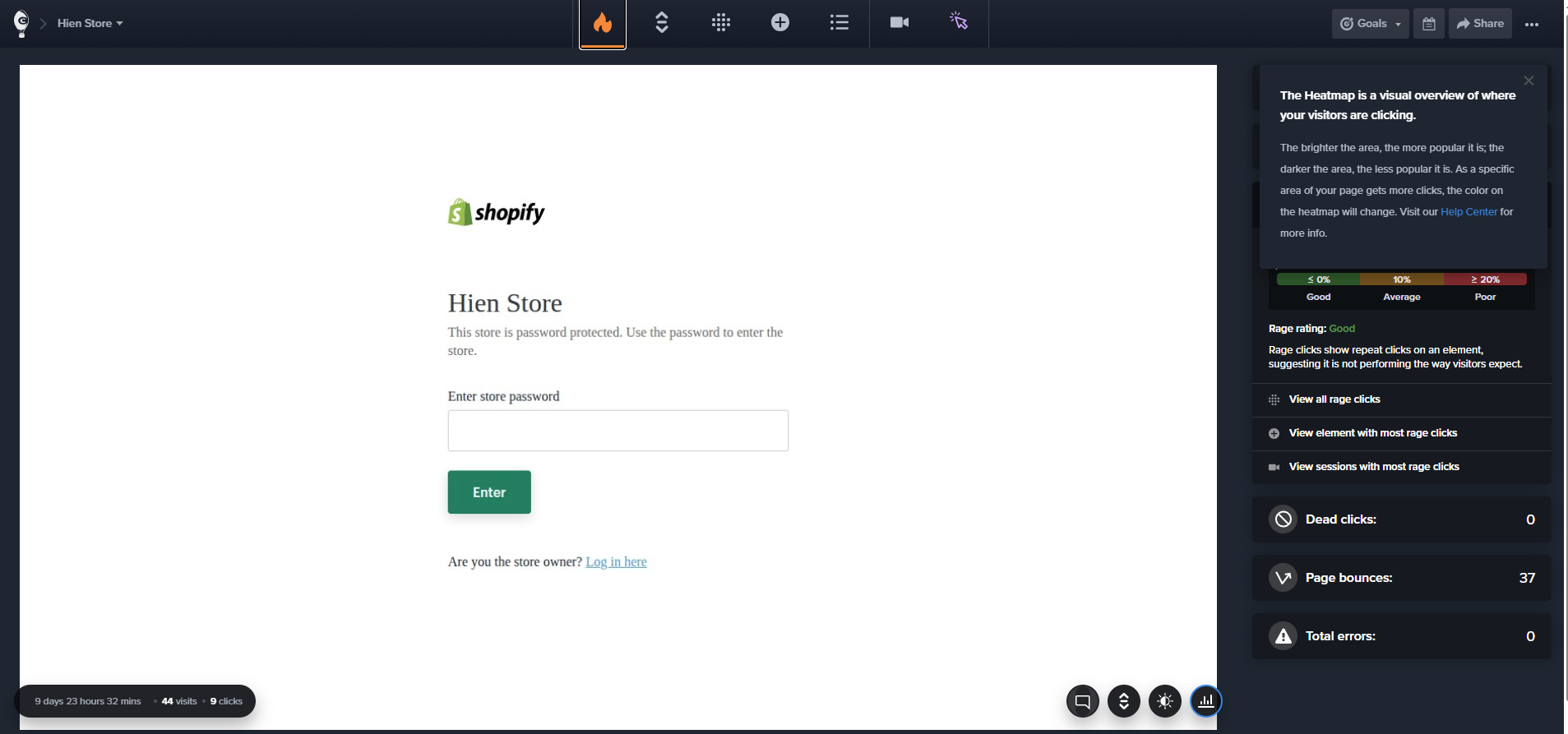
Mida’s heatmaps are revenue-focused. You see click maps, scroll depth, and cursor movement—but you also see element-level CTR and revenue per click, rage clicks, dead clicks (clicks that go nowhere), and error clicks. More importantly, every heatmap is connected to session replays. When you spot a high-interaction area or a cluster of rage clicks, you click directly into the recordings where those interactions happened. You’re not guessing why users clicked—you’re watching the exact sessions and seeing what happened next.
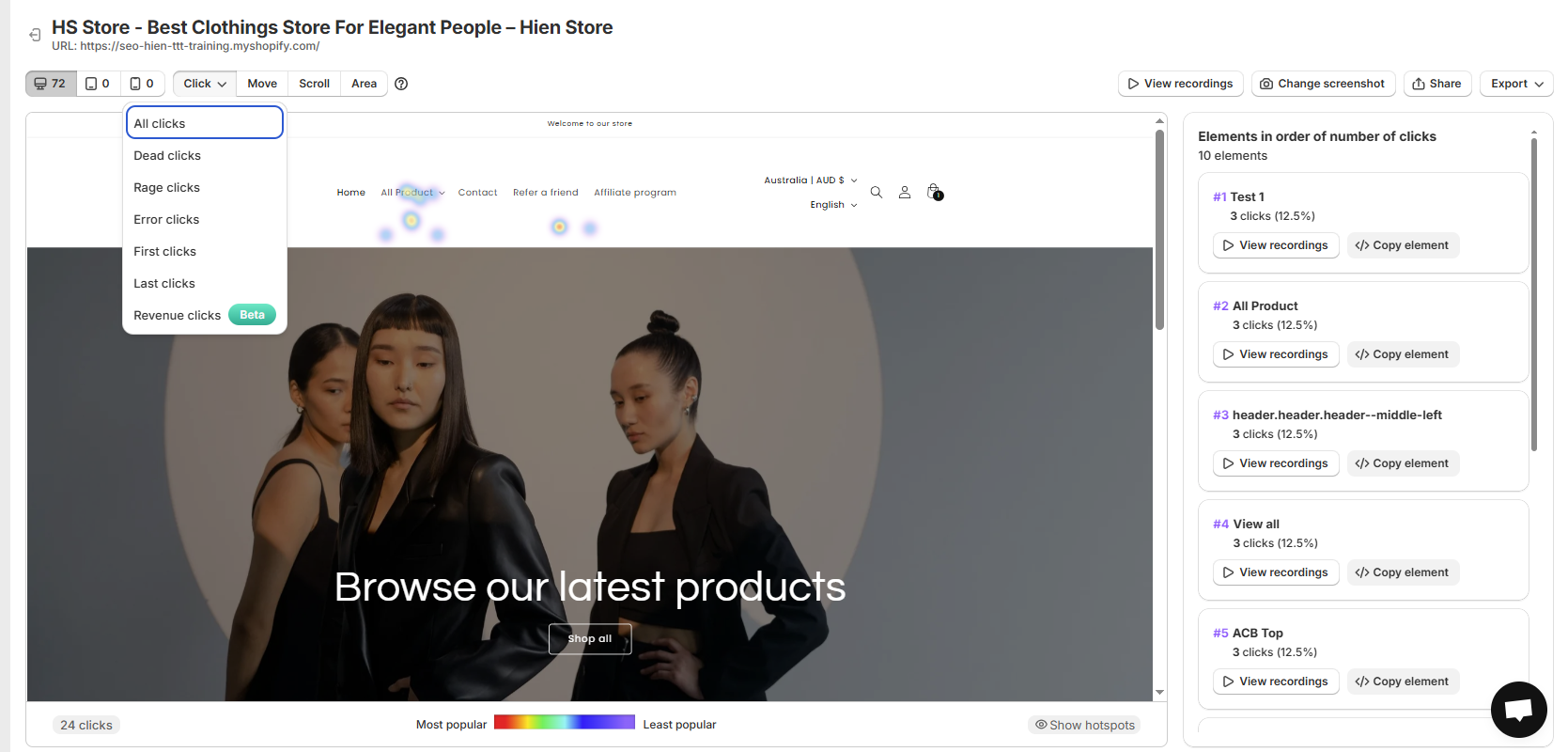
For example: your heatmap shows that 40% of mobile visitors click on a product badge, but your cart rate is low. You jump into the linked replays and discover that the badge isn’t tappable—it looks interactive but does nothing. That’s a dead click, and now you know exactly what to fix. Crazy Egg would show you the click density, but you’d have no direct path to understanding the outcome or the user’s intent.
Checkout and Funnel Visibility
Crazy Egg users have noted that “I wish there was more of a visual funnel” and that tying behavioral data to conversion steps requires manual work. The tool offers A/B testing and general analytics, but it doesn’t provide a Shopify-aware funnel that tracks product view → add-to-cart → checkout initiation → order completion with drop-off rates at each step.
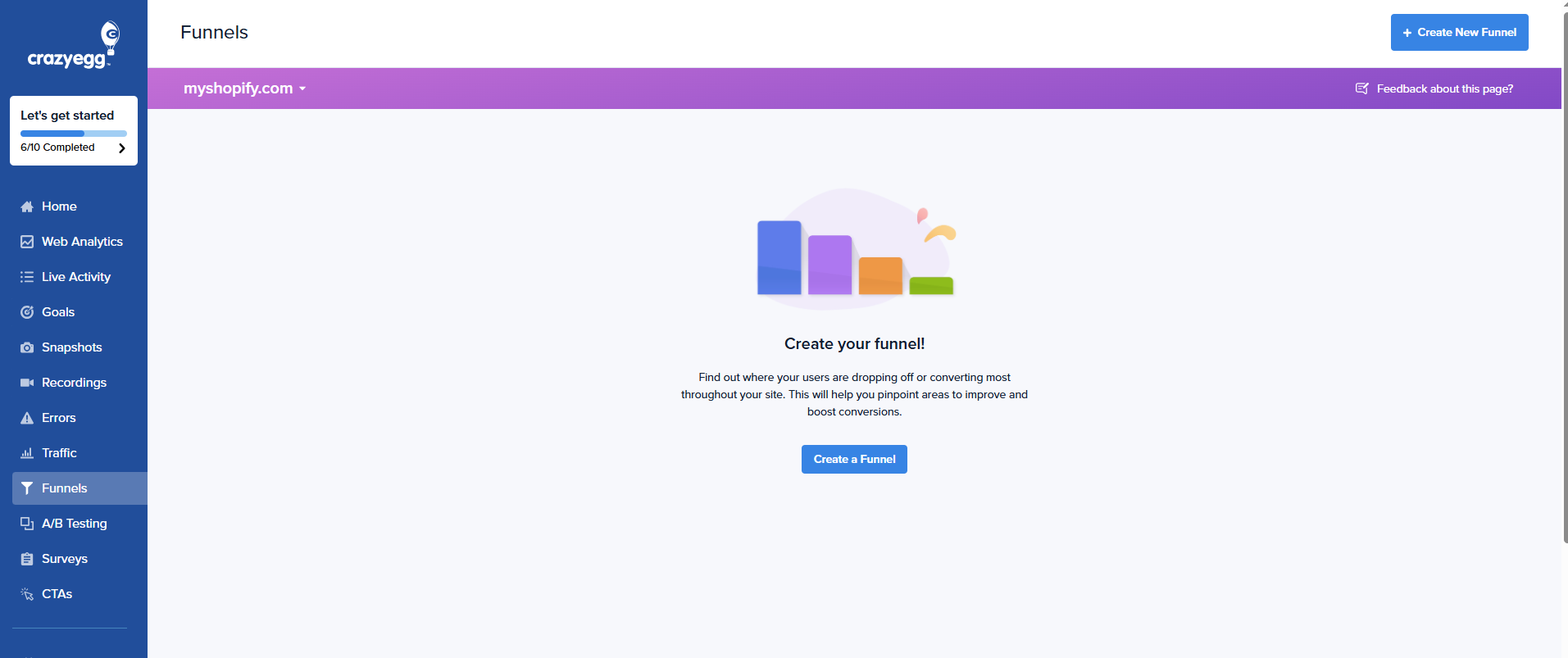
Crazy Egg doesn’t provide built-in funnel for Shopify store
Mida includes Order Funnel Visualization as a core feature. You see exactly where shoppers drop off—whether it’s on the product page (low add-to-cart rate), in the cart (high cart abandonment), or during checkout (checkout abandonment). Each funnel step is clickable, so you can drill into the sessions where drop-off occurred and watch what caused the exit. You’re not inferring problems from aggregate metrics—you’re watching the moment a shopper hesitated at shipping costs, got confused by a form field, or encountered a payment error.
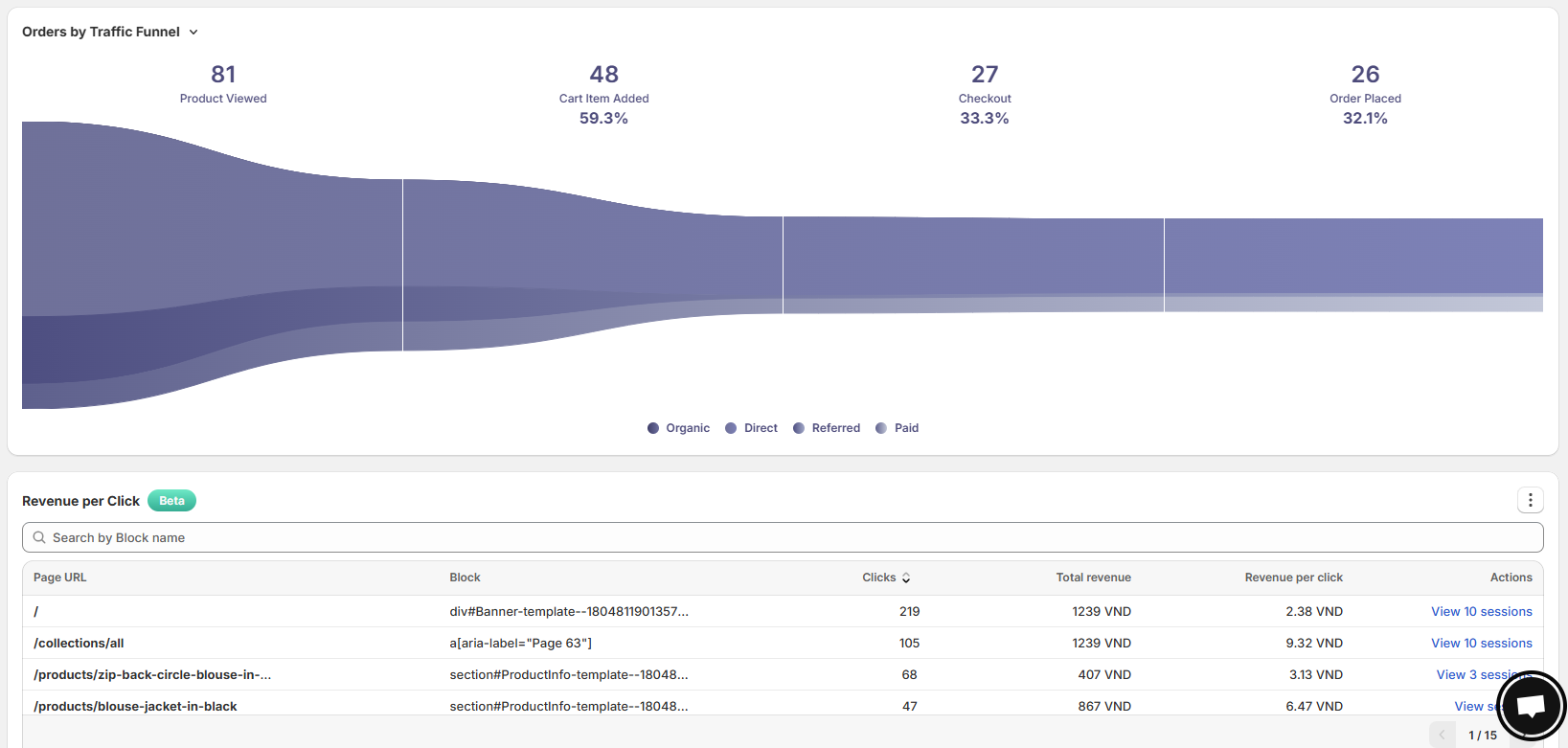
MIDA conversion funnel and revenue per click by element tracking
This is especially critical for checkout optimization. Mida records checkout events and lets you filter sessions by checkout abandonment, so you can see whether friction is caused by unexpected costs, security concerns, complex forms, or technical errors. Crazy Egg can record checkout pages if you set it up manually, but it won’t automatically segment by checkout behavior or connect recordings to Shopify’s native checkout events.
Data Export and External Analysis
A recurring complaint about Crazy Egg is that “it’s hard to export the data to analyse externally.” Users who need to integrate behavioral data with other analytics platforms, build custom reports, or perform advanced analysis in external tools find the export functionality inadequate.
Mida is designed to work within Shopify’s ecosystem, so the data you need—customer profiles, order details, cart values—is already integrated. You’re not exporting raw event streams to another tool; you’re working inside a Shopify-native dashboard where behavior, revenue, and customer context are unified. For teams that do need external analysis, Mida’s approach reduces the need for exports because the relevant ecommerce data is already connected to each session and heatmap.
User Experience and Ease of Use
Setup and Implementation
Crazy Egg users consistently praise its ease of implementation. Reviewers note that “I’m not a web dev and had zero issues installing it” and that the Chrome plugin makes setup straightforward. For general websites, Crazy Egg delivers on its promise of quick, non-technical installation.
However, one significant friction point is evaluation: users report that “I couldn’t explore the full features — like heatmaps or recordings — without adding the tracking script to a live website.” You can’t test the tool with sample data or see how it works before committing to installation. For merchants evaluating multiple tools or hesitant to add scripts during peak traffic periods, this creates unnecessary risk.
Mida installs as a native Shopify app in minutes—no code, no developer required. Because it’s built for Shopify, it automatically integrates with your store’s theme, checkout, and customer data without manual configuration. And because Mida is Shopify-native, you’re not adding a generic third-party script that might conflict with other apps or slow your store. The app is optimized for Shopify’s infrastructure, so it doesn’t impact page speed or performance.
More importantly, Mida’s interface is designed around Shopify merchant workflows. You don’t need to learn a new analytics paradigm—filters, views, and dashboards are organized around the outcomes you care about: orders, carts, checkout, and customer journeys. If you understand Shopify’s customer and order structure, you’ll understand Mida immediately.
Learning Curve and Feature Discovery
Crazy Egg’s interface is intuitive for basic use, but some users feel overwhelmed by the breadth of features. One reviewer noted, “It offers so much I feel like there are some great features I may be overlooking.” The tool provides recordings, heatmaps, A/B testing, scroll maps, confetti reports, and more—but without clear guidance on which feature to use for which problem, merchants can struggle to prioritize where to start.
Mida’s design philosophy is different: every feature is tied to a specific diagnostic question. Want to know where mobile shoppers drop off? Check the device breakdown in the Ecommerce Analytics Dashboard. Want to see why carts are abandoned? Open the Order Funnel Visualization and click the cart abandonment step to watch relevant sessions. Want to understand why a product page isn’t converting? View the heatmap, identify low-interaction elements, and jump into the replays where visitors left without adding to cart.
The interface guides you from question to insight to action. You’re not exploring features abstractly—you’re answering specific revenue and conversion questions with the right tool for each scenario.
Collaboration and Stakeholder Communication
Crazy Egg users highlight that session recordings and heatmaps are effective for stakeholder presentations—one reviewer mentioned using the tool to “create a strong argument to present to the CEO.” Visual evidence of user behavior is persuasive, and Crazy Egg makes it easy to share snapshots and recordings.
Mida takes this further by connecting every insight to revenue context. When you share a heatmap or session recording with your team or a developer, you’re not just showing clicks—you’re showing a session where a $200 cart was abandoned because a button didn’t work, or a heatmap that reveals 60% of mobile visitors never scroll to your CTA. The Shopify-native context (cart value, customer type, order outcome) makes the business impact immediately clear. You’re not asking stakeholders to infer the problem—you’re showing them exactly what’s costing revenue and what needs to change.
Pricing and Value
Cost Structure and Plan Tiers
Crazy Egg users generally find the pricing “very reasonable” compared to competitors, and there are no widespread complaints about cost. However, one user noted that “we didn’t see as much CRO value as we had hoped… likely a reflection of the specific variables we chose to test and the plan we were on,” suggesting that lower-tier plans may limit access to features needed for meaningful optimization.
The bigger issue isn’t price—it’s capacity. As noted earlier, session recording limits are a consistent pain point, especially for teams managing multiple pages or high traffic volumes. If you need more recordings, you’re forced to upgrade to a higher-tier plan, even if you don’t need the other features included in that tier. You’re paying for capacity, not capability.
Mida offers a generous free plan that includes session recordings, heatmaps, and core analytics—enough for small stores to start diagnosing friction and validating changes. Paid plans scale based on session volume and feature access, but the pricing is structured around Shopify store size and traffic patterns, not arbitrary recording caps. You’re not choosing between monitoring your homepage or your checkout—you’re getting coverage across the journeys that matter most, prioritized by relevance.
More importantly, Mida’s value isn’t just in the features—it’s in the Shopify-specific context that makes every session, heatmap, and funnel insight immediately actionable. You’re not paying for a generic analytics tool and then spending hours trying to connect it to your store’s revenue data. You’re paying for a purpose-built Shopify optimization platform where behavior and revenue are unified from the start.
Return on Investment
Crazy Egg helps you see where people click and how they navigate your site. That’s valuable for general UX improvements. But if you’re a Shopify merchant, your primary goal isn’t better engagement—it’s more revenue. You need to know which friction points are costing you orders, which product page elements drive add-to-cart, and where checkout abandonment is happening.
Mida is built to answer those questions directly. Every feature—session replay, heatmaps, funnel visualization, surveys—is designed to help you identify and fix revenue blockers. When you watch a session where a shopper with a $150 cart abandoned at checkout because they couldn’t find the “Continue” button on mobile, you’re not seeing an interesting UX quirk—you’re seeing a specific, fixable problem that’s costing you sales every day. Fix that button, and you recover revenue immediately.
That’s the ROI difference: Crazy Egg shows you behavior; Mida shows you behavior tied to revenue outcomes, so you know exactly what to fix and why it matters.
Customer Support
Responsiveness and Quality
Crazy Egg receives strong praise for customer support, with users noting that the team is responsive and helpful even for free users. One reviewer shared, “Within 10 days they had implemented a fix for my problem. As a freemium customer? I was blown away.” However, some users report that “support is sometimes a little slow to respond,” and there’s no mention of guaranteed SLAs or consistent response times for time-sensitive optimization needs.
Mida’s support is built around helping Shopify merchants act quickly. Because the tool is Shopify-native, the support team understands ecommerce-specific problems—checkout errors, cart abandonment patterns, mobile UX issues—and can provide guidance that’s immediately relevant to your store. You’re not explaining what Shopify checkout is or why cart abandonment matters; you’re working with a team that knows your platform and your goals.
More importantly, Mida’s AI-Powered Weekly Email Reports act as ongoing support. You receive automated summaries that explain your shop health score, abandoned cart trends, engagement levels, and performance patterns—so you’re not waiting for support to tell you what to look at. The tool surfaces the issues that need attention and points you to the sessions and heatmaps where you can diagnose them.
Documentation and Technical Resources
Crazy Egg users note that “there are some technical issues or quirks that aren’t described in their documentation,” requiring users to troubleshoot independently or wait for support responses. For edge cases—like CSP constraints, platform-specific conflicts, or advanced filtering—documentation gaps create friction.
Mida’s documentation is built around Shopify merchant workflows and common optimization scenarios. You’re not reading generic analytics guides—you’re following step-by-step instructions for diagnosing cart abandonment, optimizing product pages, reducing checkout friction, and interpreting heatmap signals. The documentation assumes you’re a Shopify merchant trying to grow revenue, not a data analyst trying to configure a complex tool.
Integration Capabilities
Platform Integration Depth
Crazy Egg integrates with websites via a JavaScript snippet and offers general compatibility with most platforms. It works on Shopify, but it doesn’t integrate with Shopify’s native data structures—customer profiles, order events, checkout progression, or cart details. You’re tracking page views and clicks, but you’re not tracking Shopify-specific behaviors like “checkout initiated” or “payment info entered.”
Mida is a native Shopify app, which means it integrates directly with your store’s customer, order, and checkout data. Every session recording is automatically linked to the customer profile and order record (if applicable). You don’t need to set up custom events, configure tracking for checkout steps, or manually tag sessions by customer type. The integration is automatic, and the data is unified.
This depth matters when you’re diagnosing problems. If a session shows a checkout abandonment, you can immediately see the customer’s order history, cart contents, and whether they’ve abandoned before. You’re not switching between tools or exporting data to connect behavior to outcomes—it’s all in one place.
Workflow Integration and Data Portability
As noted earlier, Crazy Egg users struggle with data export: “It’s hard to export the data to analyse externally.” If your workflow involves integrating behavioral data with other analytics platforms, CRM systems, or BI tools, Crazy Egg’s export limitations create friction.
Mida’s Shopify-native design reduces the need for external integrations because the relevant ecommerce data is already connected. Customer profiles, order values, cart contents, and checkout events are part of the session context by default. For teams that do need to share insights externally, Mida’s dashboards, heatmaps, and session replays are designed to be shareable—you can send a direct link to a specific session or heatmap, and your team or developer sees the full context immediately.
Addressing Specific Pain Points
Session Recording Limits and Enterprise Scale
The most consistent complaint about Crazy Egg is recording capacity: “The session recording limit is low for the number of pages we have running at any given time,” and “the amount of recordings are sometimes not sufficient for an organisation as big as ours.” If you’re running a large catalog, testing multiple landing pages, or operating at enterprise scale, you’ll hit limits that force you to choose which pages to monitor or miss critical sessions.
Mida’s Relevance Score and smart segmentation solve this by prioritizing the sessions that matter. Instead of recording every idle visit and running out of capacity, Mida focuses on engaged visitors, frustrated users, cart abandoners, and completed purchases. You’re not watching random traffic—you’re watching the journeys where revenue is at risk or where validation is needed. And because you can create reusable Views that automatically surface high-priority sessions, you’re not manually sifting through hundreds of recordings to find the ones worth watching.
For enterprise merchants, this approach scales better than arbitrary caps. You’re not paying for more recordings—you’re getting smarter coverage of the sessions that drive optimization decisions.
Connecting Behavior to Revenue Outcomes
Crazy Egg shows you where people click, scroll, and navigate. That’s useful for general UX improvements. But it doesn’t tell you whether a click led to a cart, whether a scroll reached your CTA, or whether a session ended in an order or an abandonment. You see behavior in isolation, and you have to manually correlate it with conversion data from another tool.
Mida connects every behavior to a revenue outcome. When you watch a session, you see the cart value, whether the visitor completed an order, and whether they abandoned at checkout. When you view a heatmap, you can filter by sessions that led to orders vs. sessions that bounced. When you analyze a funnel, you see the exact drop-off rates at each step and can drill into the sessions where abandonment occurred.
This isn’t a reporting convenience—it’s the difference between seeing interesting behavior and diagnosing revenue loss. If 40% of mobile visitors click on a product image but only 5% add to cart, you need to watch the sessions where clicks didn’t convert and see what went wrong. Mida makes that workflow instant. Crazy Egg makes it manual.
Checkout Optimization and Abandoned Cart Recovery
Crazy Egg can record checkout pages if you configure it manually, but it doesn’t automatically track Shopify checkout events or segment sessions by checkout behavior. You’re watching checkout visits like any other page, without the context of cart value, checkout progression, or abandonment reason.
Mida is built for checkout optimization. You can filter sessions by “abandoned checkout,” see the cart value and contents, and watch exactly where the shopper stopped. Did they hesitate at shipping costs? Did they encounter a payment error? Did they get confused by a form field? You’re not guessing—you’re watching the moment the checkout broke down.
This is critical for Shopify merchants because checkout abandonment is one of the biggest revenue leaks. If you can’t see what’s happening during checkout, you’re optimizing blind. Mida gives you full visibility into checkout behavior, so you can identify friction points—unexpected costs, complex forms, security concerns, technical errors—and fix them with confidence.
Mobile vs. Desktop Behavior Differences
Crazy Egg provides device-level reporting, so you can see heatmaps and recordings segmented by mobile vs. desktop. That’s useful, but it’s a general website feature—not optimized for the specific mobile commerce challenges Shopify merchants face (thumb-friendly tap targets, mobile checkout friction, scroll depth on product pages).
Mida’s cross-device analysis is built around Shopify mobile commerce patterns. You can compare mobile vs. desktop heatmaps side by side, see where mobile visitors drop off in the funnel, and filter session recordings by device to watch mobile-specific friction. For example, if your mobile cart abandonment rate is 20% higher than desktop, you can immediately watch mobile sessions where abandonment occurred and see whether the issue is a UI problem (buttons too small, form fields hard to tap) or a content problem (shipping costs displayed poorly on mobile).
This level of device-specific insight is essential because mobile behavior is fundamentally different from desktop, and mobile commerce is growing. You need a tool that helps you optimize for mobile buyers, not just track mobile visits.
Evaluation and Trial Experience
Crazy Egg users report that “I couldn’t explore the full features — like heatmaps or recordings — without adding the tracking script to a live website.” You can’t test the tool with sample data or see how it works before committing to installation. For merchants evaluating multiple tools or concerned about adding scripts during high-traffic periods, this creates unnecessary friction and risk.
Mida offers a free plan that lets you install the app, start recording sessions, and generate heatmaps immediately—no credit card required, no risk. You can evaluate the tool with real data from your store, see how the Shopify integration works, and validate whether the insights are actionable before committing to a paid plan. You’re not making a decision based on marketing promises—you’re making a decision based on actual results from your store.
Which Tool Is Right for Your Shopify Store?
Crazy Egg is a solid, general-purpose analytics tool that works across any website. If you’re running a content site, a SaaS landing page, or a non-ecommerce platform, Crazy Egg’s heatmaps, recordings, and A/B testing provide valuable behavioral insights with an intuitive interface and reasonable pricing.
But if you’re running a Shopify store, Crazy Egg’s platform-agnostic design becomes a limitation. You’re watching behavior without ecommerce context—no cart values, no checkout events, no customer profiles, no order outcomes. You see where people click, but you don’t see whether those clicks led to revenue. You watch sessions, but you don’t know which sessions represent high-value abandoners vs. idle browsers. You generate heatmaps, but you can’t connect them to the sessions where specific elements were clicked or the outcomes those clicks produced.
Mida is purpose-built for Shopify merchants who need to understand and optimize the full customer journey—from product page to checkout to order. Every session recording is linked to customer and order data. Every heatmap connects to the replays where interactions happened. Every funnel step shows you exactly where revenue is leaking and lets you drill into the sessions where drop-off occurred. You’re not watching generic website behavior—you’re diagnosing specific revenue blockers and validating the changes that drive growth.
If your goal is better engagement metrics, Crazy Egg will show you where people click. If your goal is more revenue, Mida will show you where customers get stuck, why they abandon, and what to fix next.
The choice comes down to this: Do you want a general analytics tool that works on Shopify, or a Shopify-native optimization platform that connects behavior to revenue outcomes?
For Shopify merchants focused on reducing cart abandonment, optimizing checkout, and turning traffic into orders, Mida delivers better results because it’s built for the problems you’re actually trying to solve.
See exactly what’s happening on your Shopify store—and fix what’s costing you sales.
Stop guessing why shoppers abandon carts or where your checkout breaks down. Mida shows you real customer behavior, connected to revenue outcomes, so you can optimize with confidence.


