Lucky Orange vs Hotjar: We Tested Both Tools in 2026
Lucky Orange and Hotjar both promise to show you what visitors do on your site—but they solve different problems for different teams. Lucky Orange focuses on real-time visibility and live support, while Hotjar leans into qualitative research and long-term analysis.
This comparison breaks down how each tool handles heatmaps, session recordings, surveys, and pricing so you can pick the one that matches your workflow. We also cover where both fall short for Shopify merchants who want behavior data connected to actual revenue.
>> You may also like:
- 10 Best Lucky Orange Alternatives for Conversion Optimization in 2026
- We Tested 12 Hotjar Alternatives – Here Are the Top Performers
Quick verdict on Lucky Orange vs Hotjar
Lucky Orange excels at real-time analytics, live chat, and bundled value for marketers focused on conversion rate optimization. Hotjar leads in qualitative research, advanced surveys, user interviews, and longer data retention for UX and product teams.
If you want to see what visitors are doing right now and offer instant support, Lucky Orange is your tool. If you want to understand why users behave a certain way through deep research and historical analysis, Hotjar fits better.
| Feature | Lucky Orange | Hotjar |
| Best for | Marketers, small businesses, CRO | UX teams, product managers, deep research |
| Core strength | Real-time data, live chat, all-in-one value | Advanced feedback, historical analysis |
| Pricing model | All features included per plan | Tiered by traffic volume |
| Data retention | Shorter retention window | Up to 365 days on paid plans |
Neither tool connects behavior data to actual revenue outcomes. You can see where visitors click, but you can’t filter by “visitors who added to cart” or “sessions that resulted in a purchase.”
What is Lucky Orange
Lucky Orange is a behavior analytics platform that bundles heatmaps, session recordings, live chat, and form analytics into one tool. The platform tracks visitor behavior in real time, meaning you can watch someone browse your site the moment they land on it.
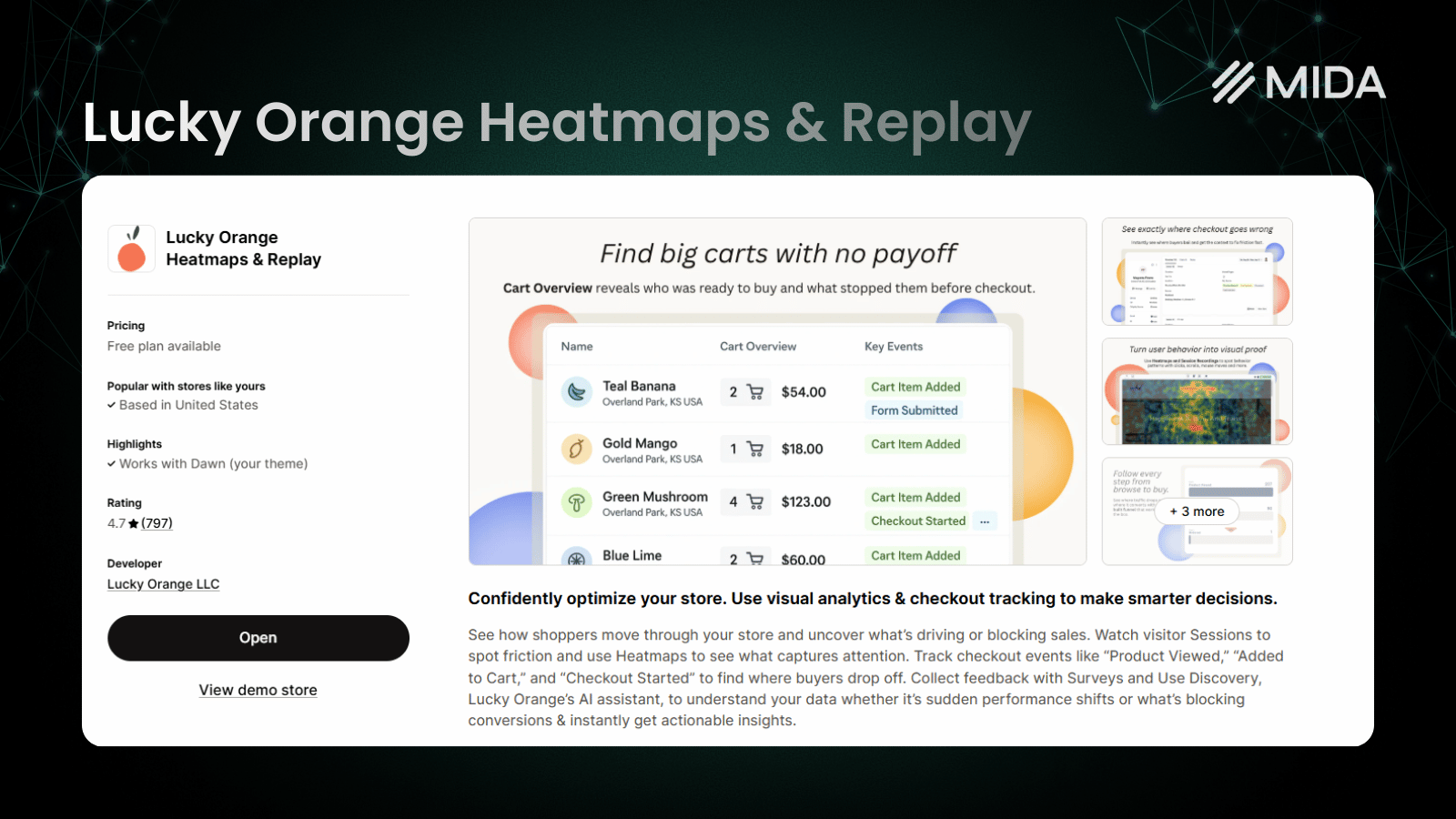
Lucky Orange company overview and key features
Lucky Orange focuses on providing an all-in-one conversion rate optimization suite. The core features include:
- Real-time visitor tracking: See who is on your site right now and what they’re doing
- Live chat integration: Engage visitors directly while watching their session
- Dynamic heatmaps: Visualize clicks, scrolls, and movement on pages with changing content like pop-ups or dropdown menus
- Form analytics: Identify which form fields cause abandonment
- Conversion funnels: Track drop-off between key steps in your customer journey
Who Lucky Orange works best for
Lucky Orange works best for marketers, small business owners, and CRO-focused teams who want immediate, actionable insights. The live chat feature makes it particularly valuable if you want to offer support while simultaneously understanding visitor behavior.
The platform also supports multiple sites under one account, which makes it cost-effective for agencies or merchants operating several stores.
What is Hotjar
Hotjar is a well-established behavior analytics and feedback platform trusted by larger companies and UX teams. The tool positions itself as the go-to platform for qualitative research—understanding the “why” behind user behavior rather than just the “what.”
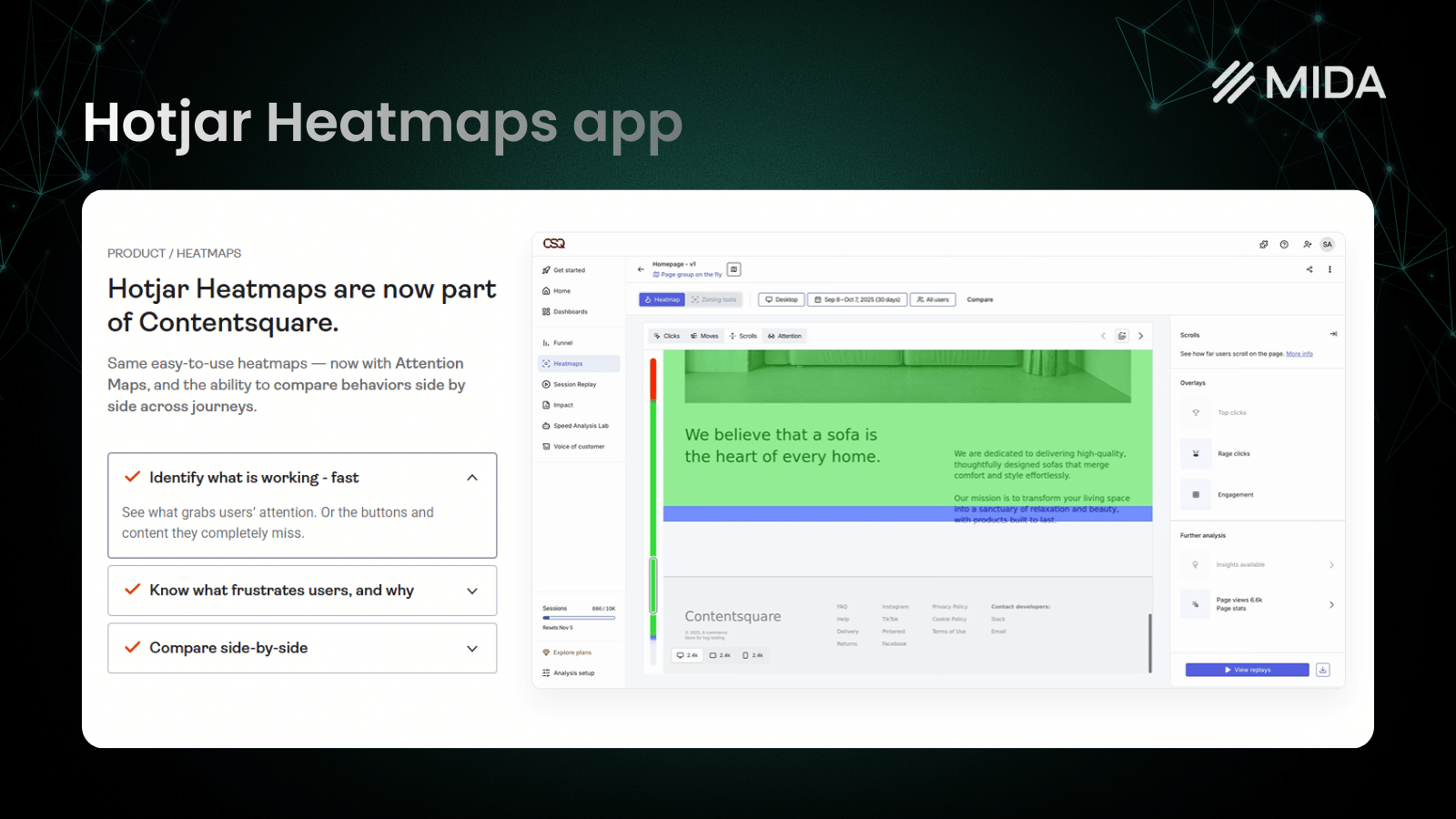
Hotjar key features
Hotjar separates its offerings into two main products: Observe (for heatmaps and recordings) and Ask (for surveys and feedback).
- Heatmaps: Click, scroll, and move visualizations with engagement zones showing which page sections hold attention
- Session recordings: Watch user journeys with advanced filtering and segmentation options
- Surveys: Deploy on-site and external surveys with branching logic for complex research
- User interviews: Recruit and schedule interviews directly through the platform
- Feedback widgets: Collect in-the-moment reactions on specific pages
Who Hotjar works best for
Hotjar works best for product managers, UX designers, and research teams at mid-to-large companies. If your optimization process involves extensive user research, prototype testing, or cross-functional collaboration between design and product teams, Hotjar’s feature set aligns well with that workflow.
How Lucky Orange and Hotjar features compare
Both tools offer overlapping core features like heatmaps and session recordings, yet they differ significantly in depth and focus. Your primary use case—real-time action versus long-term research—determines which tool serves you better.
Heatmaps
Lucky Orange offers dynamic heatmaps that work well on pages with changing content. If your store uses pop-ups, dropdown menus, or frequently updated elements, Lucky Orange captures interactions more reliably.
Hotjar provides engagement zones to see which page sections get the most attention, along with clear scroll depth visualization. The interface feels polished and the data presentation is straightforward. Neither tool connects heatmap data directly to actual revenue outcomes.
Session recordings
Lucky Orange shows real-time sessions and allows for live co-browsing with visitors—useful for immediate support scenarios. You can watch someone struggle with your checkout and jump into a chat to help them.
Hotjar offers stronger segmentation for filtering recordings and provides much longer data storage for historical analysis. If you want to compare behavior patterns from three months ago to today, Hotjar makes that possible. Both tools lack ecommerce context, so you won’t automatically know the cart value or order status associated with a recording.
Surveys and feedback tools
Hotjar’s clear strength is feedback collection. The platform offers advanced surveys with branching logic and a built-in user interview platform for deep qualitative research. You can recruit participants, schedule calls, and manage the entire research process within the tool.
Lucky Orange includes basic feedback widgets but lacks advanced survey features and interview scheduling. For teams focused on understanding user motivations through direct feedback, Hotjar wins this category.
Analytics dashboards
Lucky Orange provides built-in dashboards and allows users to create separate dashboards for different campaigns or teams. The interface feels more unified and cohesive.
Hotjar’s dashboards can feel more fragmented according to user feedback—as if different products are stitched together rather than designed as one system. Neither platform offers revenue-attributed analytics out of the box.
Funnel and conversion tracking
Both tools offer funnel visualization to track user drop-off between pages. Lucky Orange includes form field-level analytics to see exactly where users abandon a form, which helps identify specific friction points.
Hotjar focuses more on page-to-page funnels. A key limitation for both: they track page views but often miss Shopify-specific events like add-to-cart actions or specific checkout steps without custom configuration.
Lucky Orange pricing vs Hotjar pricing
The two tools have fundamentally different pricing philosophies, which affects total cost depending on your traffic volume and feature requirements.
Lucky Orange plans and costs
Lucky Orange bundles all features into each plan, scaling by session volume. You get heatmaps, recordings, live chat, and form analytics at every tier—the only difference is how many sessions you can track. Plans start at $19/month after a free trial.
Hotjar plans and costs
Hotjar splits pricing into separate products: Observe (heatmaps and recordings) and Ask (surveys and feedback). Paid plans start at $40/month for Observe, with Ask priced separately. High-traffic stores may find costs escalating quickly if you want features from both products.
Free plan limits and data retention
Both platforms offer limited free plans. The key difference is data retention—Hotjar stores data for up to one year on paid plans, while Lucky Orange retains data for shorter periods (typically 30 days on lower tiers).
Lucky Orange pros and cons
What users like about Lucky Orange
- Real-time visibility: Watch visitors browse your site as it happens
- Live chat integration: Offer support without switching tools
- All-in-one pricing: No feature gating across plans
- Easy setup: Quick installation and intuitive interface
- Multi-site support: Manage several websites under one account
Where Lucky Orange falls short
- Shorter data retention: Historical analysis is limited compared to Hotjar
- Basic feedback tools: Lacks advanced survey logic and user interviews
- No revenue attribution: Cannot connect sessions to actual orders or cart value
- Generic for ecommerce: Not built specifically for Shopify checkout flows
Hotjar pros and cons
What users like about Hotjar
- Deep qualitative research: Surveys, interviews, and feedback widgets in one platform
- Longer data retention: Access historical trends over extended periods
- Strong segmentation: Filter recordings by detailed user attributes
- Trusted platform: Well-known and widely adopted by enterprise teams
- Engagement zones: See which page sections hold user attention
Where Hotjar falls short
- Higher cost at scale: Pricing increases significantly with traffic
- Fragmented interface: Dashboards can feel like separate tools stitched together
- No real-time data: Cannot watch live visitor sessions
- No live chat: Requires a separate tool for on-site support
- No ecommerce context: Sessions are not linked to orders, cart values, or Shopify data
Ease of use and setup
Installation and onboarding
Both tools install via a simple script snippet. Lucky Orange is often praised for faster time-to-value—you can get insights within minutes of installation. Hotjar has more extensive documentation but can have a steeper learning curve for its advanced features.
Dashboard and navigation
The Lucky Orange interface feels more unified and cohesive. Everything lives in one place, and moving between features feels natural. Hotjar’s separate product areas (Observe vs. Ask) can feel disconnected to some users.
Speed to actionable insights
Lucky Orange delivers faster insights due to its real-time data capabilities. You can see what’s happening now and react instantly—useful when you’ve just launched a campaign and want immediate feedback. Hotjar requires waiting for data to be processed, which works better for retrospective analysis.
Integrations and ecommerce platform support
Shopify and WooCommerce compatibility
Both tools integrate with Shopify and WooCommerce via an app or script. However, neither is built natively for ecommerce. They treat online stores like any other website and miss commerce-specific context like customer profiles, order history, or native checkout events.
CRM and marketing tool connections
Both platforms integrate with common tools like Google Analytics, HubSpot, Slack, and Zapier. Lucky Orange connects with more live chat tools, reflecting its focus on real-time support. Hotjar integrates with more research and product management tools. Neither offers a deep, Shopify-native data sync that connects behavioral data to revenue.
Site speed impact and data accuracy
Both tools add scripts that can affect performance, though modern implementations use asynchronous loading to minimize impact. Lucky Orange is generally considered lightweight, while Hotjar’s impact can vary depending on which features are enabled.
In terms of tracking accuracy, Lucky Orange handles dynamic content better—pop-ups, dropdown menus, and frequently changing elements. Hotjar may miss interactions on pages with rapidly changing content.
When to choose Lucky Orange or Hotjar
Choose Lucky Orange if you want real-time data and live chat
Lucky Orange fits best if you want to see visitor behavior as it happens, offer instant support through integrated live chat, and prefer affordable, all-in-one pricing for multiple sites.
Choose Hotjar if you want longer data retention and interviews
Hotjar fits best if you want to understand why users behave a certain way, require in-depth feedback tools like surveys and interviews, and prioritize long-term user experience research.
Consider a Shopify-native tool if you want revenue-linked insights
If you run a Shopify store and want to connect visitor behavior to actual orders, abandoned carts, and checkout friction, a purpose-built Shopify tool gives you context that general analytics platforms miss. Tools like MIDA link sessions to customer profiles and revenue outcomes without requiring manual data stitching.
Why Shopify merchants benefit from Shopify-built analytics
What general tools miss about ecommerce
General tools like Lucky Orange and Hotjar show what visitors do, but they don’t show which behaviors led to purchases versus abandoned carts. You can see clicks but not the associated cart value. You can watch sessions but can’t filter by “first-time visitor who abandoned checkout.”
Analytics tells you that 65% of checkouts are abandoned. Heatmaps show where people clicked. But neither tells you what a $200 cart abandonment looked like compared to a $50 completed purchase.
How Shopify-native session replay connects behavior to orders
Shopify-native tools attach commerce data to every session—cart contents, order value, the exact checkout step reached, and customer type. You can watch the journey that preceded an abandoned checkout and identify the specific friction point that cost you the sale.
Try Mida free to see how revenue-linked session replay changes the way you optimize your store.
FAQs about Lucky Orange and Hotjar
Does Lucky Orange or Hotjar work better for Shopify stores?
Both integrate with Shopify, but neither is built specifically for ecommerce. They lack native connections to orders, cart data, and checkout events that Shopify merchants typically want for conversion optimization.
Can Lucky Orange and Hotjar track checkout behavior?
Both can record checkout pages if configured, but they don’t automatically capture Shopify-specific checkout events or link sessions to order outcomes without cross-referencing other data sources.
Which tool offers longer data retention?
Hotjar retains data significantly longer than Lucky Orange. Paid Hotjar plans store recordings and heatmap data for up to one year, compared to Lucky Orange’s shorter retention windows.
Does Lucky Orange show real-time visitor data?
Yes. Lucky Orange displays live visitor activity and allows you to watch sessions in real time. Hotjar processes data with a delay and does not offer real-time viewing.
Are all features included in Lucky Orange plans?
Lucky Orange includes all features at every pricing tier, with limits on session volume. Hotjar separates features across different products and plans that scale by traffic.


